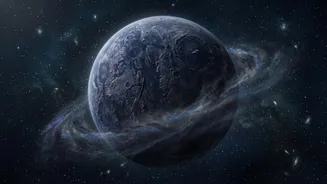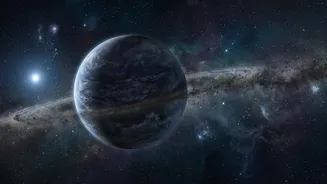


In a cosmic mystery worthy of a detective novel, a planet that was once a celebrated discovery seemingly vanished. Now, astronomers believe they have cracked the case, revealing a story more violent and surprising than anyone imagined.
A Ghost in the Stars
Imagine discovering
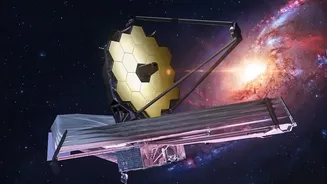
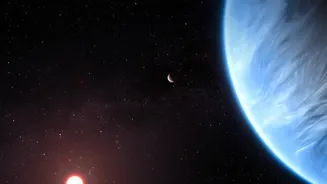
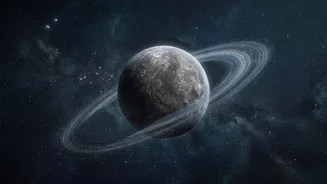
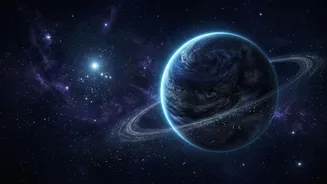
a new world, a planet orbiting a distant star 25 light-years away. For astronomers in 2004, this wasn't imagination. Using the Hubble Space Telescope, they captured images of a bright dot moving through the cosmos, a candidate for one of the first exoplanets ever seen in visible light. They named it Fomalhaut b, and it was a star in its own right—a symbol of humanity's expanding vision into the universe. It was celebrated as a massive world, perhaps three times the size of Jupiter. But this celestial celebrity had a secret. Early on, there were clues that something was amiss. The 'planet' was strangely bright in visible light yet had no detectable heat signature in the infrared, which a large gas giant should possess. This was the first hint that Fomalhaut b was not what it seemed.
The Curious Case of a Vanishing World
For a decade, astronomers watched Fomalhaut b. But instead of confirming its status as a planet, the observations only deepened the mystery. As they tracked its journey around its star, they noticed it was not only following a highly unusual path but was also growing fainter. Then, in 2014, the unbelievable happened: Fomalhaut b disappeared. When astronomers reviewed the Hubble images from that year, the once-bright dot was gone, completely vanished from sight. Planets, especially massive ones, do not simply fade away. A bona fide planet, as one scientist noted, should not be doing this. The scientific community was left with a baffling puzzle. Where did the planet go? Did it speed away into deep space, or was there a more dramatic explanation for its vanishing act?
A Cosmic Collision
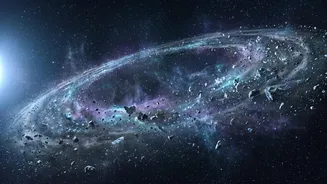
The answer, as proposed by a team of astronomers from the University of Arizona, was as explosive as it was elegant: Fomalhaut b was never a planet at all. By analysing all the available Hubble data, they concluded that what observers had first seen in 2004 was not a solid world, but an enormous, expanding cloud of dust and ice. They believe they had been a witness to the immediate aftermath of a titanic collision between two massive, icy bodies, each around 200 kilometres in diameter. This was not the discovery of a planet, but a rare, real-time observation of two planetesimals—the building blocks of planets—smashing into each other. What Hubble had photographed was the glowing, expanding debris from this cataclysmic event.
The Dust Cloud Hypothesis
This new theory perfectly explained the object's bizarre behaviour. The cloud of fine dust, created by the impact, would have been brightly illuminated by the light of the central star, Fomalhaut, which explains why it was so bright in visible light. It also explained the lack of an infrared heat signature, as the tiny dust particles would be too small to retain heat. The reason it 'disappeared' is that the dust cloud continued to expand. Over a decade, the debris spread out over an area larger than Earth's orbit around the sun. Eventually, the particles became so dispersed and tiny—each smaller than the width of a human hair—that the cloud grew too faint for even the powerful Hubble telescope to detect. The planet hadn't vanished; the evidence of the cosmic crash had simply drifted apart.
Rewriting the Rules of Discovery
The story of Fomalhaut b is a powerful example of the scientific method in action. An initial observation led to a hypothesis—a planet—which was then tested by further observations. When the evidence no longer fit, scientists had to find a new explanation, leading to a deeper and more accurate understanding. Witnessing such a massive collision is incredibly rare, giving researchers a unique window into the violent and chaotic processes that form planetary systems, including our own. It’s a blueprint for how planets are made and, in some cases, how they are destroyed. While Fomalhaut b has now been removed from the official list of exoplanets, its story has provided something arguably more valuable: a firsthand look at the dynamic, ever-changing nature of the cosmos, where even a 'mistake' can lead to a profound discovery.