



Welcome to the 'Hot Jupiters'
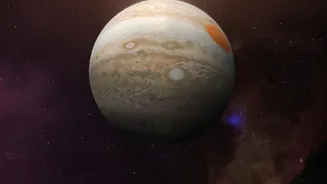
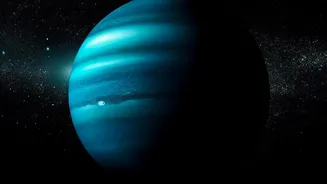
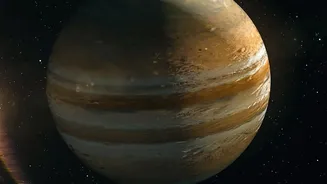
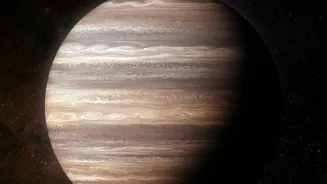
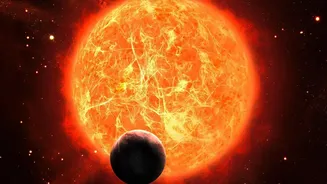
The most extreme weather in the known universe is found on a class of exoplanets called 'hot Jupiters'. These are gas giants similar in size to our own Jupiter, but they orbit incredibly close to their parent stars—much closer than Mercury orbits our sun.
This proximity has a dramatic effect. These planets are often 'tidally locked', meaning one side permanently faces the star in perpetual daylight, while the other is trapped in eternal night. This creates an environment of extreme temperature differences that drives weather systems unlike anything in our solar system. The dayside can reach scorching temperatures over 2,400 degrees Celsius, hot enough to vaporise metals like iron.
Winds Faster Than The Speed of Sound
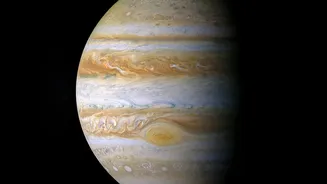
The massive temperature gradient between the blistering hot dayside and the cooler nightside of these planets generates ferocious winds. We're not talking about a strong gale; these are winds that can reach speeds of up to 18,000 kilometres per hour, and in some cases, even faster. For comparison, the fastest winds ever recorded on Jupiter are around 1,500 km/h. These atmospheric currents on hot Jupiters are truly supersonic, transporting heat and vaporised elements from the day side to the night side at incredible speeds. On the exoplanet WASP-43 b, for instance, scientists have measured equatorial winds whipping around the planet at over 8,000 km/h.
When It Rains Molten Iron
One of the most astonishing discoveries is the phenomenon of iron rain, observed on planets like WASP-76b, located about 640 light-years away. On its dayside, the extreme heat vaporises iron into a gas. These powerful, supersonic winds then carry the iron vapour across the planet to the terminator—the line between day and night. As the iron vapour reaches the cooler nightside, where temperatures drop to around 1,500 degrees Celsius, it condenses back into a liquid. This condensed iron then falls from the sky as droplets of molten rain. Because these are gas giants, there is no solid surface for the iron rain to collect on; it simply sinks deeper into the planet's dense atmosphere until it gets hot enough to vaporise again.
How Scientists Map Alien Skies
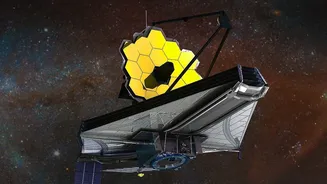
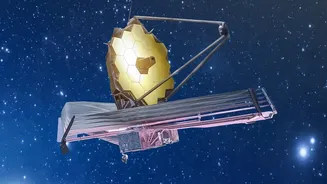
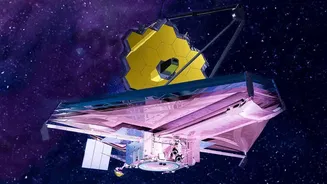
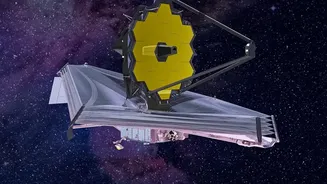
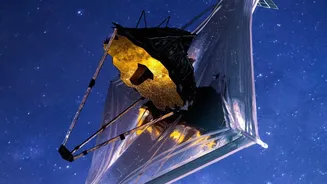
Astronomers can't see these planets directly with a telescope. Instead, they use clever techniques to map their atmospheres from light-years away. One primary method is called transmission spectroscopy. When an exoplanet passes in front of its star from our point of view, starlight filters through the planet's atmosphere. By analysing the spectrum of this light, scientists can identify the chemical elements present, such as iron vapour. Instruments like the ESPRESSO spectrograph at the Very Large Telescope and the James Webb Space Telescope (JWST) have been crucial. By observing how the chemical signature changes as the planet rotates, they can deduce that iron is present on the dayside but disappears on the nightside, inferring that it has condensed and rained out of the upper atmosphere.
Why We Study Extreme Weather
Studying these bizarre weather systems isn't just about cataloguing cosmic curiosities. These extreme planets are natural laboratories that allow scientists to test and refine their models of atmospheric physics under conditions that don't exist in our solar system. Understanding the dynamics of hot Jupiters provides crucial insights into how planets form, migrate, and evolve. Furthermore, characterising the atmospheres of different types of exoplanets is a critical step in the search for life elsewhere. Learning to distinguish between various atmospheric compositions helps astronomers know what to look for when they eventually point their telescopes at smaller, rockier, and potentially habitable worlds.