



The Challenge: Seeing the Unseeable
Planets outside our solar system, known as exoplanets, are incredibly difficult to see directly. They are small, faint, and hopelessly lost in the blinding glare of the stars they orbit. For decades, finding them was a matter of detecting the subtle wobble
of a star or the slight dip in its brightness as a planet passed in front. But discovering a planet is only the first step. The ultimate goal for many astronomers is to understand what these worlds are made of, particularly their atmospheres. The composition of an atmosphere can offer clues about a planet's climate, its geology, and most tantalisingly, its potential to harbour life. This is where JWST's incredible instruments come into play, moving beyond mere detection to detailed characterisation.
The Starlight Sieve: Transmission Spectroscopy
To analyse an atmosphere it can't directly see, JWST uses a clever technique called transmission spectroscopy. It relies on a perfect cosmic alignment: an exoplanet passing directly between its star and the telescope. This event is called a transit. As the planet transits, a tiny fraction of the starlight filters through the very edge of the planet's atmosphere. While the planet itself blocks most of the light, this thin atmospheric ring acts like a sieve, absorbing certain wavelengths of light while letting others pass through. By carefully measuring the star's light before, during, and after the transit, astronomers can isolate the light that has been altered by the planet's atmosphere.
Webb’s Infrared Advantage
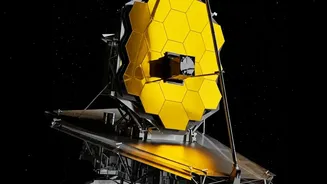
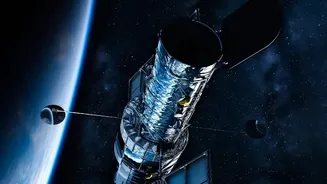
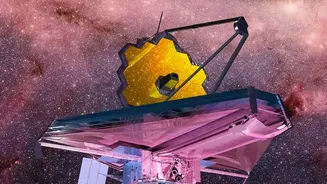
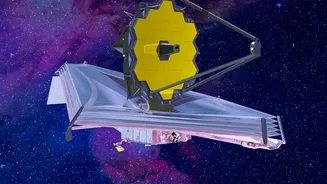
Previous telescopes like the Hubble Space Telescope could perform spectroscopy, but JWST has a superpower: its unparalleled sensitivity to infrared light. Many of the most interesting molecules for scientists—including water, methane, and carbon dioxide—happen to leave their most distinct fingerprints in the infrared part of the spectrum. These are the very molecules that could indicate a planet’s biological or geological activity. Furthermore, infrared light is better at penetrating the clouds and hazes that can otherwise obscure an atmosphere, giving scientists a clearer view of the chemistry within. JWST's large mirror and advanced spectrographs are specifically designed to capture this faint, infrared starlight with astonishing precision, opening a new era in exoplanet research.
Decoding a Chemical Barcode
The data JWST collects is not a picture, but a spectrum—essentially a graph showing the brightness of light at different wavelengths. When an exoplanet's atmosphere absorbs starlight, it creates dips in this graph, known as absorption lines. Each molecule absorbs light at a unique set of wavelengths, creating a pattern that acts like a chemical barcode. Water has one barcode, methane has another, and carbon dioxide has its own distinct signature. By matching the observed absorption lines to the known patterns of different molecules, scientists can determine precisely what gases are present in the exoplanet's atmosphere, and even estimate their abundance. It’s this decoding process that turns a stream of data into a map of another world’s sky.
From Data to Groundbreaking Discoveries
This powerful technique has already yielded remarkable results. JWST has provided definitive detections of water in the atmospheres of hot gas giants like WASP-96 b and has begun studying temperate, Saturn-sized worlds. For instance, recent observations of the temperate gas giant TOI-199b revealed the presence of methane, with hints of ammonia and carbon dioxide. In other cases, JWST has investigated the inner, rocky-planet-forming zones of young star systems and found water vapour, a crucial ingredient for life, available where Earth-like planets might be assembling. Even non-detections are significant; recent observations of the rocky exoplanet GJ 486 b initially hinted at water vapour, but follow-up data suggested the planet has little to no atmosphere at all, refining our understanding of planetary survival. Each observation adds a vital piece to the puzzle of planetary formation and habitability.