




Sailing on Beams of Light
It sounds like science fiction, but the principle is rooted in fundamental physics. Light is composed of particles called photons. While photons have no mass, they do possess momentum. When a photon strikes a surface and bounces off, it transfers that
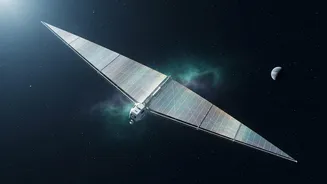
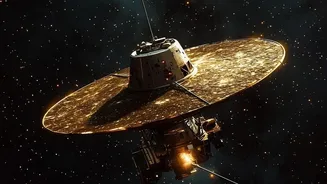
momentum, giving the surface a tiny push. Imagine a constant stream of microscopic tennis balls hitting a wall; each impact is minuscule, but collectively they exert a noticeable force. A solar sail is essentially a vast, ultra-thin, mirror-like sheet designed to catch a constant stream of photons from the Sun. This continuous bombardment provides a gentle but unending push, known as solar radiation pressure, accelerating the spacecraft through the frictionless vacuum of space.
The Ultimate Advantage: No Fuel Required
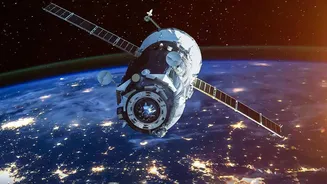
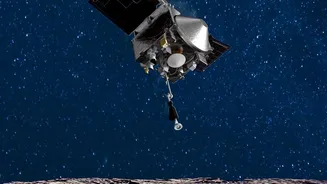
The single greatest challenge for long-distance space missions is fuel. Chemical propellants are heavy, expensive to launch from Earth, and finite. Once a conventional spacecraft runs out of fuel, its mission is effectively over. Reflective sail technology sidesteps this issue entirely. By using sunlight as its propellant, a solar sail spacecraft has a virtually limitless source of energy. This completely changes the economics of space travel. It eliminates the need for massive fuel tanks, which in turn dramatically reduces the overall weight of the spacecraft. A lighter craft is cheaper to launch and can ultimately reach higher speeds over time than a chemical rocket that burns its fuel in short, powerful bursts.
From Theory to Reality
Solar sailing is no longer just a theoretical concept. Japan's IKAROS mission, launched in 2010, became the first spacecraft to successfully demonstrate controlled solar sailing as its main form of propulsion during its journey toward Venus. More recently, The Planetary Society's crowdfunded LightSail 2 mission, which flew from 2019 to 2022, proved that this technology could be used to change a spacecraft's orbit around Earth using only the power of sunlight. These successful demonstrations have paved the way for more ambitious projects. NASA has been developing its own solar sail technologies, like the Advanced Composite Solar Sail System (ACS3), which tests next-generation lightweight booms that are crucial for deploying ever-larger sails.
Challenges and Future Horizons
Despite its immense potential, the technology has limitations. The thrust provided by solar pressure is very small, meaning acceleration is slow and gradual. This makes solar sails unsuitable for high-thrust maneuvers, such as launching from Earth's surface or making rapid orbital changes. A conventional rocket is still needed to get the spacecraft into orbit in the first place. Furthermore, the push from sunlight diminishes the farther the spacecraft travels from the Sun, reducing its effectiveness in the outer solar system. To address this, some concepts propose using powerful, ground-based lasers to push sails on interstellar journeys, a concept known as "beam sailing." This could one day enable probes to reach neighboring star systems within a human lifetime.