






The Challenge of an Invisible Giant
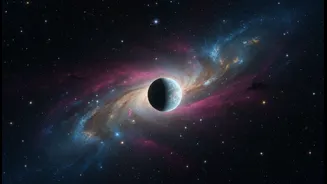
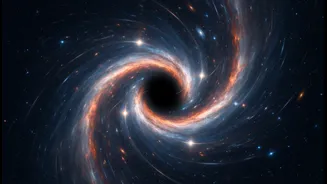
A stellar-mass black hole is the final stage in the life of a truly massive star, one many times the mass of our Sun. When such a star exhausts its nuclear fuel, its core collapses under its own immense gravity, creating a point of such intense density
that nothing, not even light, can escape its grasp. This is why they are called 'black' holes – they emit no light of their own, making them impossible to see directly with telescopes. With potentially millions of these objects lurking in our own Milky Way galaxy, astronomers needed to develop indirect methods to confirm their existence. The key turned out to be finding black holes that weren't alone.
A Cosmic Dance Reveals a Secret
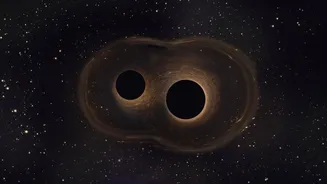
Many stars exist in binary systems, orbiting a common center of gravity with a partner. If one of those partners is a black hole, its presence can be inferred by its gravitational tug on the visible star. Astronomers can observe a star moving in a way that suggests it's orbiting an unseen, massive companion. They use two main techniques. The 'radial velocity' method measures the star's speed as it moves towards or away from us. Its light waves are compressed (blueshifted) as it approaches and stretched (redshifted) as it recedes, revealing an orbit around a hidden object. Another method, astrometry, involves precisely tracking a star's tiny 'wobble' against the backdrop of more distant stars. By measuring the visible star's orbit, scientists can calculate the mass of its invisible companion. If the mass is greater than three times that of our sun—too massive to be a neutron star—then the only known object it could be is a black hole.
Dinner Time Gives the Game Away
A more dramatic way a black hole reveals itself is when it's actively 'feeding' on its companion star. In close binary systems, the black hole's powerful gravity can pull material—mostly gas and dust—from the outer layers of its partner star. This stolen material doesn't fall straight in. Instead, it forms a swirling, superheated structure called an accretion disk. As the gas particles spiral inward, friction and intense gravitational forces heat them to millions of degrees. This incredibly hot material radiates a tremendous amount of energy, not as visible light, but as powerful X-rays. Telescopes designed to see this X-ray radiation can spot these systems, known as X-ray binaries, from across the galaxy. The X-ray glow acts like a bright neon sign, pointing directly to the location of an otherwise invisible black hole.
The Search for the Silent Majority
While X-ray binaries are bright and relatively easy to spot, scientists believe most stellar-mass black holes are 'dormant'—they aren't actively feeding and thus don't produce X-rays. These represent a silent majority, much harder to detect. However, modern astronomical surveys are changing the game. By monitoring the positions and movements of billions of stars with unprecedented precision, missions are now able to spot the subtle astrometric wobble caused by dormant black hole companions. This has led to a new wave of discoveries, finding black holes that would have been missed by traditional X-ray searches. It's a painstaking process, akin to finding a needle in a cosmic haystack, but it is opening a new window into understanding the full population of these enigmatic objects in our galaxy.