




The Challenge: Tiny Sensors in the Dark
At its core, photography is about capturing light. Professional DSLR cameras use large sensors and lenses to physically gather as much light as possible, which is why they excel in the dark. Smartphone cameras, however, are tiny by necessity. Their small
sensors simply can't collect enough light in a single shot at night without introducing a major problem: digital noise. This noise appears as a grainy texture that ruins image detail. In the past, the only way to compensate was to increase the camera's light sensitivity (ISO), which made the noise even worse, or use a long exposure, which would result in blurry star trails due to the Earth's rotation.
The Software Solution: Multi-Frame Processing
Instead of trying to beat physics with a single perfect shot, modern smartphones cheat using software. The technique is called multi-frame processing. When you press the shutter in Night Mode, the phone doesn't take one picture; it rapidly captures a burst of multiple images in just a few seconds. Some frames might be taken at different exposure levels—some darker to preserve bright stars, and some brighter to capture faint details. This collection of images is the raw material the phone's processor will use to construct a final, much better photograph.
Stacking Images to Beat the Noise
Once the burst of frames is captured, the real magic begins. The phone's software aligns all the images in a digital "stack." This is especially tricky for astrophotography, as the stars will have moved slightly between each frame due to the Earth's rotation. Advanced algorithms can identify the stars and align them perfectly. The primary goal of stacking is to improve the signal-to-noise ratio. The 'signal' (the light from the stars) is consistent in every frame, while the 'noise' (the random grain) is different in each shot. By averaging all the frames together, the consistent signal gets stronger, and the random noise effectively cancels itself out. The result is a final image that is dramatically cleaner and more detailed than any single frame could be on its own.
AI Gets in on the Act
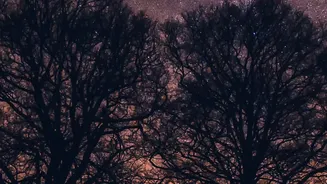
Multi-frame processing is heavily enhanced by Artificial Intelligence. The phone’s processor doesn’t just blindly stack the images; it intelligently analyzes them. AI helps in several key ways. First, it performs scene recognition, identifying that you're pointing the camera at the sky and activating the appropriate mode. Some systems even use semantic segmentation to process the sky differently from the foreground. For example, it might sharpen the details of a tree in the shot while applying a different noise reduction algorithm to the sky. It also helps select the sharpest frame from the burst to use as a reference, ensuring the final image is crisp.
Creating a Brighter, Richer Image
Beyond just noise reduction, stacking allows the phone to create a High Dynamic Range (HDR) image. By combining frames taken at different exposures, the software can preserve details in both the brightest stars and the darkest parts of the sky, creating a single image with a much greater range of light and shadow than would otherwise be possible. This is why the moon doesn't just look like a white blob in modern smartphone photos. This computational approach simulates the effect of a very long exposure without needing a tripod and avoids the associated star trails. It's a clever software solution that overcomes the physical limitations of a small camera sensor, effectively turning your phone into a powerful astrophotography tool.