


A New Eye on the Cosmos
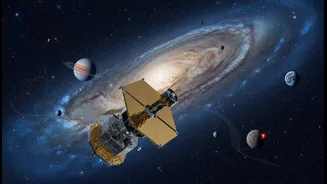
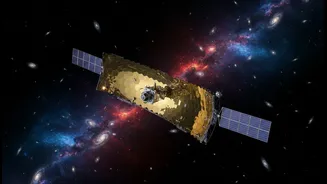
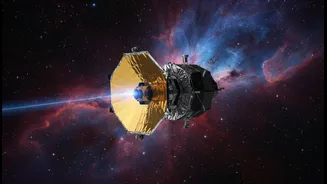
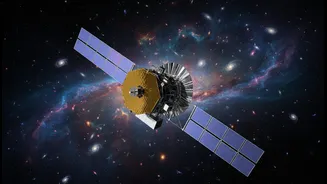
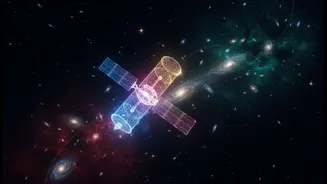
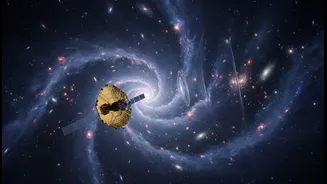
Set to launch by late 2026, the Nancy Grace Roman Space Telescope is NASA's next great observatory. Named after the agency's first chief of astronomy, Roman has a primary mirror the same size as the Hubble Space Telescope but with a crucial advantage:
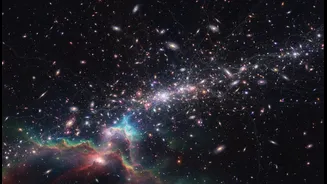
a panoramic field of view 100 to 200 times wider. This incredible breadth will allow it to survey vast swathes of the sky with unprecedented speed. While Hubble might take years to map a certain area, Roman could do it in a matter of days. This survey power is precisely what’s needed to gather the enormous amount of data required to address the universe's biggest questions, chief among them the mystery of its accelerating expansion.
The Universe's Biggest Puzzle
Ever since Edwin Hubble's discovery in the 1920s, we've known the universe is expanding. The fabric of space itself is stretching, causing distant galaxies to recede from us. In the late 1990s, another bombshell dropped: this expansion is speeding up, driven by a mysterious force dubbed 'dark energy'. But a crisis has emerged in cosmology, known as the 'Hubble tension'. When scientists measure the expansion rate using 'local' objects like nearby supernovae, they get one number (around 73 km/s/Mpc). When they use light from the 'early' universe, like the cosmic microwave background radiation left over from the Big Bang, they get a different, slower number (around 67 km/s/Mpc). Both measurements are precise, yet they disagree. This discrepancy suggests there might be something fundamentally wrong with our understanding of the cosmos.
Three Cosmic Clues
Roman will tackle this problem with a three-pronged strategy, leveraging its wide view to create the largest cosmic maps ever. First, it will hunt for thousands of Type Ia supernovae. These exploding stars are known as 'standard candles' because they always detonate with roughly the same intrinsic brightness, allowing astronomers to calculate their distance with great accuracy. By comparing their distance to their redshift (how much their light has been stretched by cosmic expansion), scientists can chart the expansion history of the universe. Second, Roman will map the distribution of billions of galaxies to study 'Baryon Acoustic Oscillations' (BAOs). These are giant, frozen ripples in the distribution of matter, left over from sound waves in the early universe. They provide a 'standard ruler' to measure distances and cosmic growth. Third, the telescope will measure 'weak gravitational lensing,' the subtle way the light from distant galaxies is bent by the gravity of intervening dark matter. This will create a map of where dark matter is and how that structure has grown over time, which is influenced by dark energy.
More Than Just Expansion
While solving the Hubble tension is a primary goal, Roman's capabilities make it a versatile tool for all kinds of astronomy. Its wide, deep surveys are expected to discover a treasure trove of new worlds. Using a technique called gravitational microlensing, Roman is projected to find thousands, and possibly up to 100,000, new exoplanets, including rocky worlds far from their stars that other methods might miss. The telescope is also equipped with a Coronagraph Instrument, a technology demonstrator designed to block the overwhelming glare of a star, which could allow for the direct imaging of planets orbiting it. Beyond exoplanets, Roman will study everything from the formation of stars and galaxies to mysterious, star-shredding supermassive black holes in the early universe.