



The Universe's Sleeping Giants
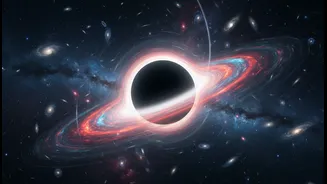
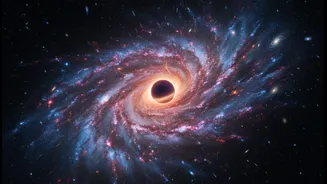
Imagine an object with the mass of millions or even billions of suns, compressed into a single point. This is a supermassive black hole, and astronomers believe one resides at the centre of nearly every large galaxy. For most of their lives, these black holes
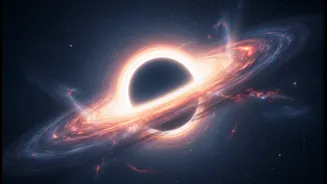
are not the voracious monsters of popular culture. If there's no material nearby for them to feed on, they enter a quiet, or 'quiescent', state. In this dormant phase, they don't emit light and are incredibly difficult to detect directly. We only know they're there because of their immense gravitational pull, which influences the orbits of nearby stars. Our own galaxy's black hole, Sagittarius A*, is currently in such a dormant state.
A Star's Unlucky Path
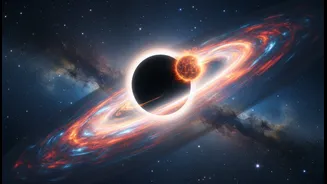
The quiet life of a black hole can change dramatically when a star wanders too close. Just as the Moon's gravity creates tides on Earth, a black hole exerts an immense tidal force on any approaching object. If a star's orbit brings it within a certain distance, known as the tidal disruption radius, the black hole's gravitational pull on the near side of the star becomes overwhelmingly stronger than on the far side. This difference in force is so powerful that it stretches the star apart, a process colorfully nicknamed 'spaghettification'. The star is violently ripped to shreds in what astronomers call a Tidal Disruption Event, or TDE.
The Cosmic Meal That Flips a Switch
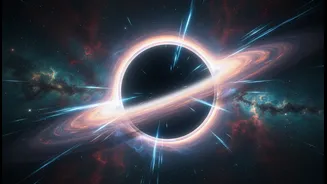
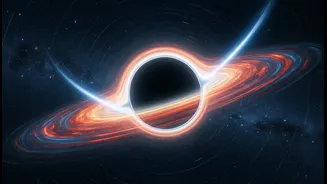
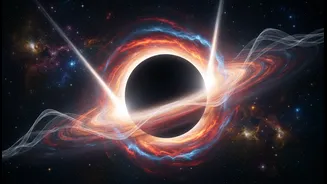
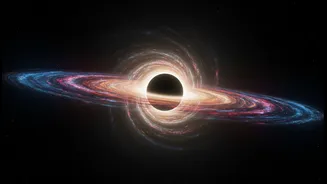
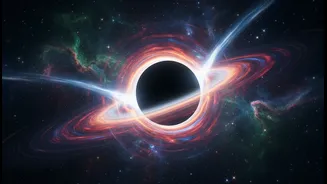
A TDE is a messy affair. The black hole doesn't just swallow the star whole. Instead, the shredded stellar material is pulled into a swirling, chaotic vortex around the black hole. About half of the star's material gets flung back out into space, while the other half is captured into orbit, forming a vast, hot, donut-shaped structure called an accretion disk. This disk of superheated gas and dust, leftover from the consumed star, becomes the fuel that awakens the sleeping giant.
From Darkness to Blazing Light
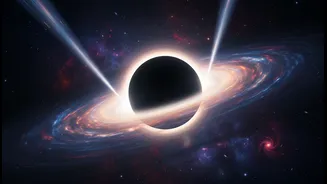
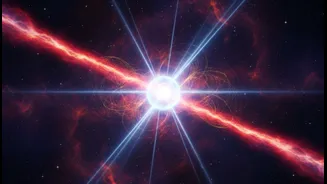
This is the moment of 'activation'. As the material in the accretion disk spirals inwards towards the black hole's event horizon, it accelerates to incredible speeds. Intense friction and magnetic forces within the disk heat the gas to millions of degrees, causing it to glow with mind-boggling brightness across the electromagnetic spectrum, from X-rays to visible light. This sudden, brilliant flare of radiation is the tell-tale sign that the dormant black hole is now feeding. For a time, this newly 'active' galactic centre can outshine all the billions of other stars in its host galaxy combined, becoming what is known as a quasar or an Active Galactic Nucleus (AGN). The star, in its final moments, has effectively switched the black hole on.
Why These Events Matter
Observing a TDE is a rare opportunity for astronomers. These events, which unfold over months, provide a unique natural laboratory to study the properties of otherwise invisible black holes. By analysing the light from these cosmic flares, scientists can estimate the black hole's mass and spin, and learn more about the extreme physics at play in the most gravitationally intense environments in the universe. Each time a star is consumed, it briefly illuminates one of the cosmos's darkest secrets, confirming the powerful link between a black hole's activation and the consumption of a nearby star.