



An Unlikely Climate Archive
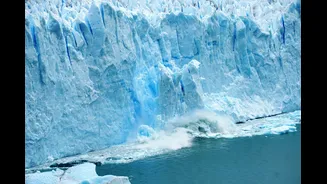
Glaciers and polar ice sheets are built up over hundreds of thousands of years, with each year's snowfall compressing the layers beneath it. This process creates a pristine, vertical timeline of Earth’s history. Just as archaeologists dig through layers of soil,
climate scientists drill deep into the ice to extract long cylinders called ice cores. These cores can be several kilometres long, providing a detailed record stretching back as far as 800,000 years. Within these layers, scientists find trapped air bubbles that preserve samples of ancient atmosphere, allowing them to measure past concentrations of greenhouse gases like carbon dioxide. But the ice holds more than just air; it also captures tiny solid particles that were floating in the atmosphere when the snow originally fell.
The Journey of a Dust Particle
Deserts are one of the planet’s primary sources of atmospheric dust. Powerful winds can lift vast quantities of fine mineral particles from arid regions like the Sahara in Africa or the Gobi Desert in Asia. These particles are so small they can travel for thousands of kilometres high in the atmosphere. Eventually, these airborne particles are washed out of the sky by precipitation. When this happens over polar regions, the dust becomes trapped in the falling snow. That snow gets buried and compacted, encasing the dust particle in a layer of ice that corresponds to a specific year or even a season. The deeper a particle is found within an ice core, the further back in time it was deposited.
Decoding the Dusty Clues
Once an ice core is extracted, scientists can analyse its chemical and physical properties. The amount of dust in a given layer is a key indicator of past conditions. A higher concentration of dust often points to a period of increased aridity or stronger winds, suggesting that deserts were larger or the climate was drier. For example, dust levels found in ice cores from the last glacial period are significantly higher—by a factor of 15 to 80—than in layers from our current warm period, the Holocene. This points to much more extensive desert landscapes and different atmospheric circulation patterns during the Ice Age.
Tracing Dust to Its Source
Beyond just quantity, the chemical makeup of the dust tells its own story. By analysing the specific mineralogy and isotopic ratios of elements like strontium and neodymium in a dust particle, scientists can pinpoint its geographic origin with remarkable accuracy. This is because different deserts have unique geological fingerprints. Studies have shown that dust in Greenland ice cores often originates from East Asian deserts, while dust found in Antarctica is frequently traced back to Patagonia in South America. This allows researchers to reconstruct not just the intensity of past arid periods, but also which specific deserts were expanding or contracting, providing a detailed map of historical environmental change.
A Window into Our Planet's Systems
This research is more than just a history lesson; it's a vital tool for understanding our planet's interconnected climate systems. By seeing how deserts responded to past temperature shifts, scientists can refine the computer models used to predict future climate scenarios. For instance, the discovery of a 'Green Sahara'—a period thousands of years ago when the desert was lush and dotted with lakes—was confirmed by a dramatic drop in Saharan dust found in ice cores. Understanding the natural cycles that caused these dramatic shifts helps put modern, human-driven climate change into perspective and highlights how sensitive these vast ecosystems can be to global temperature changes.