






A Salty Ring Around Jupiter
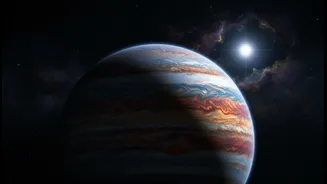
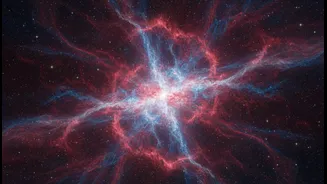
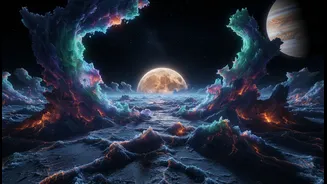
The most dramatic example of salt in space isn't just a pinch—it's a giant, doughnut-shaped cloud that orbits Jupiter. This structure, known as the Io plasma torus, is fed by one of the most violent places in the solar system: Jupiter's moon, Io. Io is a volcanic
nightmare, boasting over 400 active volcanoes that constantly spew materials like sulfur and, as scientists have discovered, salt compounds into space. These materials are stripped from Io's thin atmosphere by Jupiter's immense magnetic field, becoming electrically charged particles, or plasma. As Jupiter rotates, it drags this plasma along, creating a massive, glowing ring of super-hot gas that includes sodium and potassium—the core components of salts. This isn't just a faint haze; it's a powerful feature that generates trillions of watts of power and is visible to astronomers on Earth.
The Volcanic Salt-Shaker
So how does a moon become a giant salt-shaker for the solar system? The answer lies in tidal heating. Io is caught in a gravitational tug-of-war between the colossal Jupiter and its neighboring moons, Europa and Ganymede. This constant pulling and stretching generates immense friction inside Io, heating its interior and creating a subsurface magma ocean. This intense geological activity powers its hundreds of volcanoes, which don't just erupt with lava, but also with gases like sulfur dioxide and sodium chloride—table salt. At a rate of about two tons per second, volcanic material is launched from Io, with some escaping its weak gravity and feeding the plasma torus that encircles Jupiter. This process has been happening for an incredibly long time, constantly replenishing the salty cloud and shaping the magnetic environment around the gas giant.
Clues to a Hidden Ocean
While Io's salt clouds are spectacular, another salty detail closer by offers even more profound implications. Jupiter's other famous moon, Europa, is also believed to have salt, but not in a giant cloud. Instead, evidence points to sodium chloride on its icy surface. Scientists using the Hubble and James Webb space telescopes have identified yellowish patches on Europa's surface, particularly in geologically young areas, that match the spectral signature of irradiated table salt. This is an electrifying discovery because Europa is thought to have a vast liquid water ocean beneath its miles-thick ice shell. The presence of sodium chloride on the surface strongly suggests that this water is chemically similar to Earth's oceans and that it is interacting with the icy crust above. The salt likely originates from the ocean below, brought to the surface through plumes or upwelling, hinting at an active world.
Why This Weird Detail Is Worth Saving
The phrase "save the detail" isn't about literally protecting the clouds, but about preserving our ability to study them and appreciating their significance. The presence of sodium chloride on Europa, for example, hints that its ocean floor might host hydrothermal vents—the same kind of environments where life is thought to have begun on Earth. This makes Europa one of the most promising places to search for extraterrestrial life. Elsewhere, astronomers have even found evidence of salt clouds around distant exoplanets and young stars, suggesting they could be a common feature in planetary systems. These "weird" details are cosmic breadcrumbs. They help scientists understand planetary formation, atmospheric chemistry, and the conditions necessary for habitability. By investing in missions like the James Webb Space Telescope and the Europa Clipper, we are ensuring that we can continue to uncover these crucial clues and piece together the story of our universe.