
Seeing the Sun’s Fiery Crown
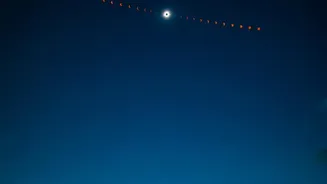
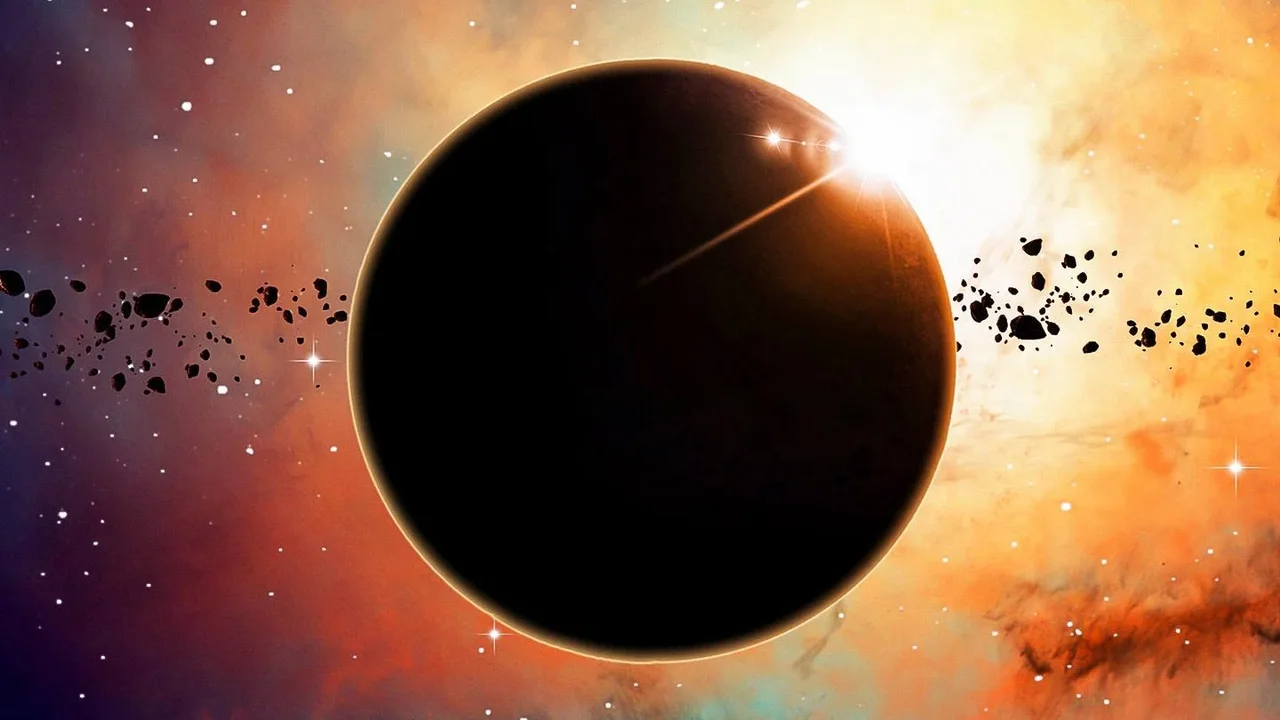
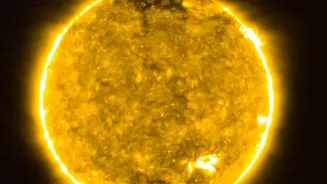
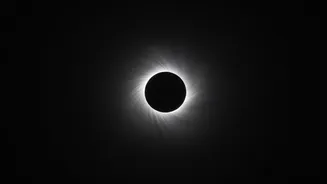
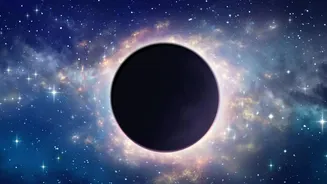
The most stunning sight during a total eclipse is the sun’s corona, its ethereal outer atmosphere. Normally, the sun's surface, or photosphere, is so blindingly bright that it completely washes out the much fainter corona. It’s like trying to see a candle
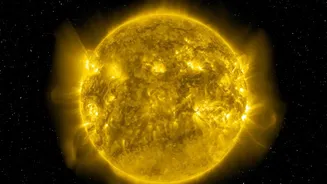
flame next to a searchlight. But when the Moon acts as a natural screen, the corona reveals itself as a pearly white crown of plasma, streaming millions of kilometres into space. This brief, unfiltered view allows researchers to study its complex structure of loops and streamers, which are shaped by the sun's magnetic field. Scientists use this time to understand one of the sun's greatest paradoxes: why the corona is hundreds of times hotter than the surface below it, reaching temperatures of millions of degrees Celsius.
A Fleeting Glimpse of Red
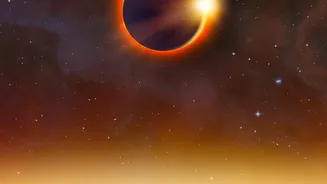
Just before and after totality, for a few fleeting seconds, a thin, reddish-pink layer can be seen around the edge of the moon. This is the chromosphere, a layer of the sun's atmosphere sandwiched between the photosphere and the corona. Its characteristic red colour comes from the abundance of hydrogen emitting light at a specific wavelength. The chromosphere is a highly active and irregular layer, thousands of kilometres thick, where the temperature begins its dramatic climb from about 6,000 to 20,000 degrees Celsius. It is usually only visible with specialised filters, but an eclipse provides a direct, albeit brief, look at this dynamic region, helping scientists understand the transfer of energy and matter into the corona.
Proving Einstein Right
Solar eclipses have also played a starring role in one of the most important scientific confirmations of the 20th century. In 1915, Albert Einstein proposed in his theory of general relativity that gravity is not a force, but a curvature of space and time caused by massive objects. This theory predicted that light from distant stars would bend as it passed by the sun's immense gravity. Under normal circumstances, it's impossible to see stars close to the sun. However, during the total solar eclipse of 1919, astronomer Arthur Eddington led expeditions to Brazil and Príncipe to photograph the starfield around the blotted-out sun. By comparing these images to photos of the same stars taken at night months earlier, they could measure the deflection. The measurements confirmed Einstein's predictions, providing crucial early evidence for his revolutionary theory and making him a household name.
Studying Space Weather and Earth's Air
Understanding the corona is not just an academic exercise; it has practical implications for us on Earth. The corona is the source of the solar wind, a continuous stream of charged particles that flows out through the solar system. Violent solar events like coronal mass ejections (CMEs) can disrupt satellites, power grids, and communications systems. Eclipse observations give scientists a clearer view of the region where the solar wind is born and accelerated, helping them improve models for predicting space weather. Furthermore, the sudden drop in sunlight affects Earth's own atmosphere. Researchers use eclipses to study these changes, launching weather balloons to measure how the boundary layer of air closest to the ground and the ionized upper layer, the ionosphere, react to the temporary darkness.
New Tools for New Discoveries
While the fundamental reasons for studying eclipses remain, the tools have become far more advanced. For the recent eclipse on August 12, 2026, which was visible over parts of Europe, NASA deployed a high-altitude WB-57 jet to chase the moon's shadow. Flying at 50,000 feet, above the clouds, the jet's instruments could capture high-resolution images of the corona in multiple wavelengths for a longer duration than on the ground. Each eclipse is unique because the sun is constantly changing through its 11-year activity cycle. These modern observations, combined with data from space-based solar observatories, provide a more complete picture of our star's behaviour, ensuring that even a celestial event watched for millennia can still yield new and exciting science.