





Understanding Cosmic Lighthouses
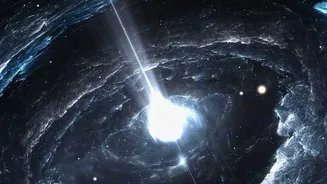
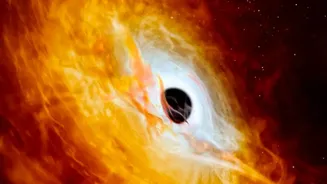
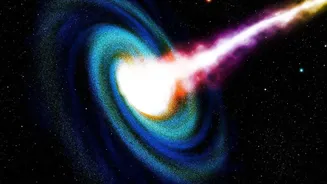
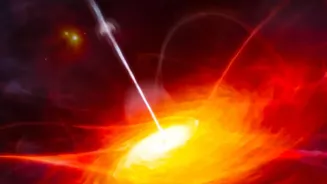
Before diving into the discovery, it's important to understand what a quasar is. Short for 'quasi-stellar object', a quasar is the intensely luminous core of a distant galaxy. This brilliant light is not from stars but is generated by a supermassive black
hole at the galaxy's center. As the black hole voraciously consumes surrounding gas and dust, the material forms a spinning accretion disk. The incredible friction and gravitational forces heat this disk to millions of degrees, causing it to radiate a torrent of energy that can outshine all the stars in its host galaxy combined. Because they are so bright, quasars act as cosmic lighthouses, allowing astronomers to peer back in time and study the conditions of the very young universe.
A Landmark Webb Discovery
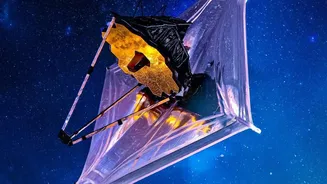
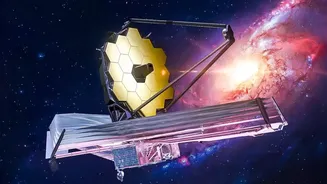
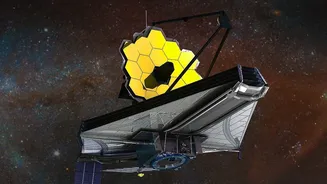
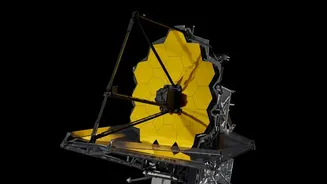
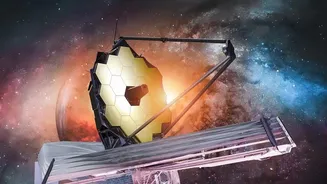
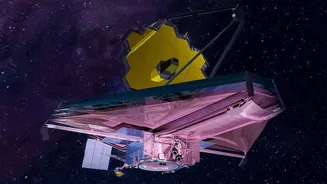
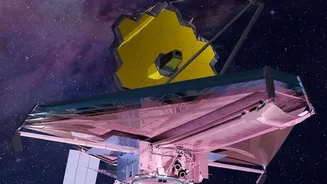
Using its powerful infrared instruments, the JWST, in collaboration with the Gemini North telescope in Hawai'i, identified a remarkable system designated J1602+4228AB. Lovingly given the Hawaiian nickname Nāpōwawāʻenakaulua, this system consists of two quasars seen as they were just 900 million years after the Big Bang. This is an incredibly early period in cosmic history known as the 'Cosmic Dawn', when the first stars and galaxies were just beginning to form. The two quasars are exceptionally close, separated by only about 18,100 light-years—a fraction of the Milky Way's diameter. This makes them the most distant, and therefore oldest, compact quasar pair ever found.
The Significance of the Pair
Finding one quasar from this era is a significant achievement; finding two so close together is a puzzle that challenges current cosmological models. The central mystery is their size. The two black holes powering the quasars are enormous, with estimated masses of 1.5 billion and 400 million times that of our sun. According to existing theories, black holes simply shouldn't have had enough time to grow this massive so early in the universe's 13.8-billion-year history. As Silvia Onorato, a lead researcher on the study, noted, there is no definitive theoretical explanation for how even one of these giant quasars could exist so early, let alone a pair. The discovery suggests that the processes of black hole growth and galaxy formation might have been far more rapid and chaotic than previously imagined.
A Glimpse into Galactic Mergers
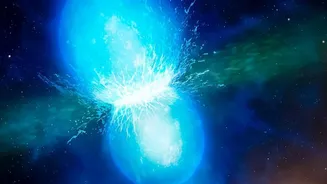
The leading explanation for this cosmic conundrum is that we are witnessing two galaxies in the process of a chaotic merger. In the early universe, galactic collisions were thought to be common, and these events are crucial for growth. Such an interaction would funnel vast amounts of gas and dust toward the central black holes of both galaxies, providing the fuel needed to ignite them as brilliant quasars simultaneously. This discovery provides the first direct evidence of such a merger happening at this extreme distance and early time, offering astronomers a unique laboratory to study how the first massive galaxies assembled. It is a snapshot of a foundational process that shaped the structure of the cosmos we see today.
A Window to the Past, Not a Threat
The immense power of a quasar—capable of boiling Earth's oceans if it were as close as Pluto—can sound alarming. However, the second part of the headline is crucial: this is a discovery, not a danger. The key is the immense distance involved. The light from Nāpōwawāʻenakaulua has been travelling for nearly 13 billion years to reach us. We are not seeing a present event, but an image of the distant past. All known quasars are incredibly far away, a feature of the young universe, meaning their radiation poses no threat to Earth. The nearest known quasar is hundreds of millions of light-years away. Instead of a nearby hazard, this discovery is a precious time capsule, allowing us to understand the violent but formative events that built the universe.