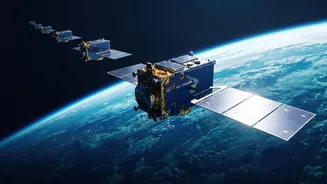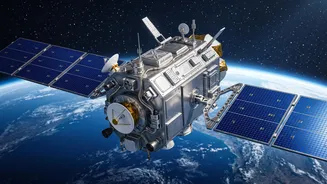




Our daily lives are silently governed by a fleet of satellites orbiting overhead. A new study reveals just how fragile this system is, showing how a hypothetical nuclear blast in space could bring our connected world to a standstill.
A Digital Doomsday Scenario
Imagine a world where
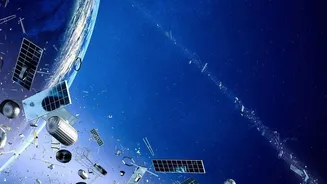
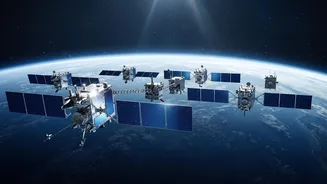
GPS fails, global communications cease, and weather forecasts go dark. This isn't the plot of a science fiction movie, but the potential outcome explored by recent computer simulations. A study has modelled the effects of a single, high-yield nuclear weapon detonated at a high altitude, hundreds of kilometres above the Earth's surface. The findings are stark: such an event could disable the vast majority of satellites in low-Earth orbit (LEO), the busiest region of space that is home to over 10,000 active satellites. Researchers simulated a one-megaton blast—a powerful but not unheard-of yield—and found that within a month, over 99% of LEO satellites could be rendered inoperable, regardless of whether they were 'hardened' against radiation. The study highlights a critical vulnerability in our global infrastructure, which has become deeply dependent on these orbiting assets for everything from banking and navigation to emergency services.
The Invisible Weapon: Artificial Radiation Belts
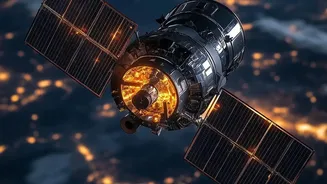
A nuclear explosion in space doesn't destroy satellites with a conventional blast wave, as there is virtually no air to carry it. Instead, it unleashes a far more insidious and lingering threat: radiation. The detonation releases a massive pulse of gamma rays and other energetic particles. When these particles interact with the Earth's magnetic field, they don't just dissipate; many become trapped, forming a new, intense, and entirely artificial radiation belt around the planet. This man-made hazard acts like a permanent storm of destructive energy. Every time a satellite passes through this belt—which it would do repeatedly in its orbit—its sensitive electronics are bombarded with high-energy electrons. This cumulative exposure gradually degrades and ultimately fries the circuits, causing the satellites to fail. The models show that even satellites specifically designed to resist radiation would eventually succumb to this relentless assault.
A Historical Precedent: Starfish Prime
This terrifying scenario is not purely theoretical. In 1962, the United States conducted a high-altitude nuclear test called Starfish Prime, detonating a 1.4-megaton warhead 400 kilometres over the Pacific Ocean. The resulting electromagnetic pulse (EMP) was far stronger than anticipated, causing electrical damage in Hawaii nearly 1,500 kilometres away, where it knocked out streetlights and disrupted telephone links. More consequentially, the test created its own artificial radiation belt that had devastating effects on the small number of satellites in orbit at the time. In the months following the test, at least a third of all satellites in low-Earth orbit failed, including the UK's first satellite, Ariel 1, and the pioneering Telstar communications satellite. The radiation from Starfish Prime lingered in space for years, serving as a stark, real-world demonstration of the long-term consequences of a nuclear event in space.
Hardening the Heavens
Given the catastrophic potential, the question of protection becomes urgent. Can we shield our vital space infrastructure from such a threat? The answer is complicated. 'Radiation hardening' is a standard practice in satellite design, involving shielding critical components and using specialised, resilient microelectronics to withstand the harsh environment of space. These measures are effective against naturally occurring radiation from the sun and cosmic rays. However, the intense and persistent radiation from a nuclear event is several orders of magnitude greater. While hardening can prolong a satellite's life, current commercial methods are not designed to withstand such an extreme scenario indefinitely. Shielding against all forms of nuclear radiation is often impractical due to the immense weight it would add—a critical constraint when launching anything into orbit. Researchers are exploring innovative solutions like specialised coatings that could offer better, lightweight protection against EMP and radiation, but a foolproof defence remains a significant engineering challenge.