
Venus: The Hostile Sister Planet
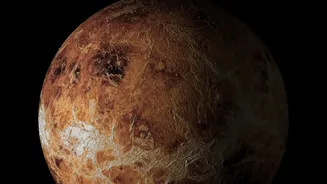
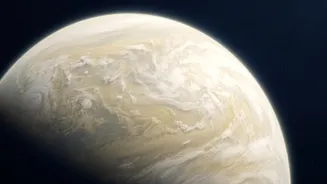
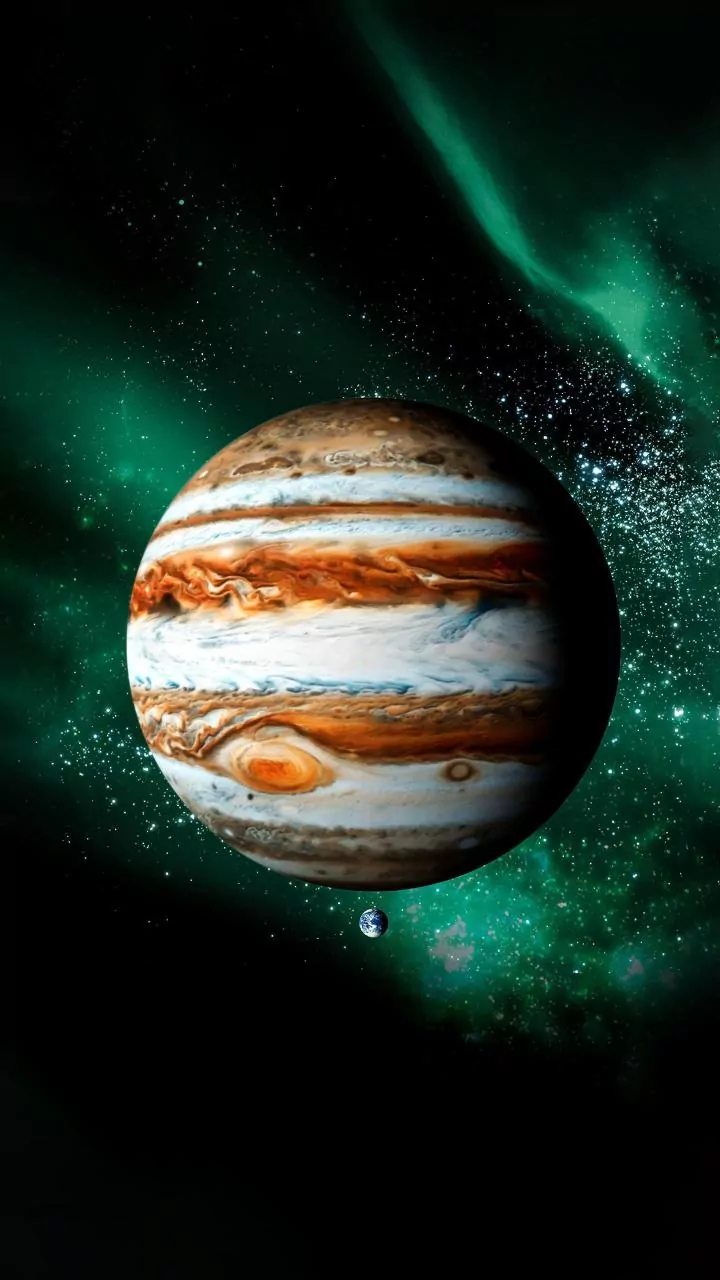
Venus and Earth may be similar in size, but they could not be more different. Venus is the hottest planet in our solar system, with surface temperatures that can melt lead. Its atmosphere is over 96% carbon dioxide, creating a runaway greenhouse effect
that serves as a stark cautionary tale for our own planet's climate. This entire world is permanently shrouded in thick clouds of sulfuric acid, making its surface completely invisible to conventional telescopes. For decades, scientists have been trying to understand the mysteries hidden beneath this veil: Is there active volcanic or seismic activity? What drives the planet's super-rotating atmosphere? These are some of the fundamental questions ISRO aims to answer with its ambitious Venus Orbiter Mission.
Introducing Shukrayaan-1
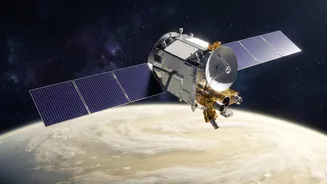
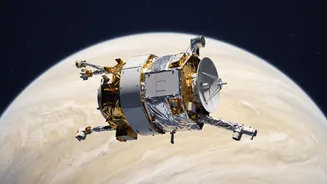
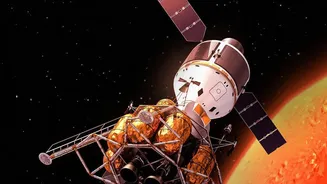
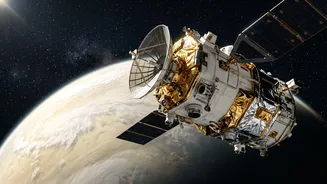
Shukrayaan-1, which translates to 'Venus Craft', is India’s first-ever mission to our neighbouring planet. Formally approved by the Union Cabinet in September 2024, the mission is currently scheduled for a launch in March 2028 aboard the powerful LVM-3 rocket. Following the success of the Mangalyaan Mars mission, Shukrayaan-1 represents ISRO's next major leap in interplanetary exploration. The orbiter will carry a scientific payload of around 100 kg, comprising instruments from India as well as international partners like Russia, France, Sweden, and Germany. The mission has three primary objectives: to map the surface and subsurface, to study the chemistry and dynamics of the atmosphere, and to investigate the interaction between Venus and the solar wind.
The Star Instrument: Synthetic Aperture Radar
The single most critical piece of technology for peering through Venus's opaque cloud cover is the Synthetic Aperture Radar, or SAR. Unlike optical cameras that need light, radar works by sending out microwave signals and analysing the echoes that bounce back. These microwaves can effortlessly penetrate the dense clouds, darkness, and any weather conditions. Shukrayaan's high-resolution SAR is designed to map the Venusian surface with a resolution up to four times better than NASA's Magellan mission from the 1990s. This will allow scientists to create detailed topographical maps, identify lava flows, and look for signs of active volcanism. Uniquely, the mission will also carry a ground-penetrating radar, making it the first to ever study the shallow subsurface of Venus, offering clues about its geological layers.
Decoding a Toxic Atmosphere
While the SAR maps the ground, a host of other instruments will focus on the atmosphere itself. One key payload is VIRAL (Venus InfraRed Atmospheric Gases Linker), a collaborative instrument designed to analyse the chemical composition of the atmosphere in great detail. This and other spectrometers will measure the distribution of various gases, monitor the structure of the thick clouds, and study the planet's extreme winds that whip around it in just four Earth days. Another instrument, a lightning sensor, will investigate whether electrical discharges occur within the Venusian clouds, a long-debated topic. These sensors will work together to create a comprehensive picture of the atmospheric dynamics, from the cloud tops down to near the surface.
Hunting for Clues of a Living Planet
Beyond mapping and atmospheric studies, Shukrayaan-1 will also investigate how Venus interacts with its space environment. Without a strong magnetic field like Earth's, Venus's upper atmosphere is directly exposed to the solar wind—a constant stream of charged particles from the Sun. Instruments co-developed with Swedish and German partners will study this interaction, helping scientists understand how the solar wind strips away atmospheric particles, a process that may explain why Venus lost its water. Furthermore, thermal cameras will scan the surface for hotspots that could indicate active volcanoes. By studying its geology, atmosphere, and space environment, the mission will provide a holistic view of how a planet so similar to Earth evolved so differently.