

The Solar System’s Time Capsules
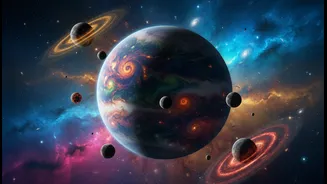
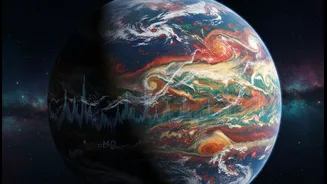
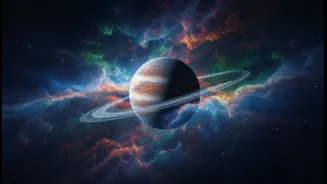
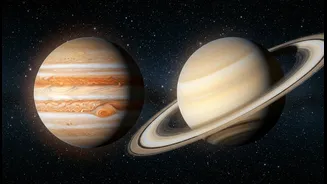
Our solar system is home to four giant planets, but Jupiter and Saturn are the true titans. Composed mostly of hydrogen and helium, they are fundamentally different from rocky worlds like Earth. Think of them less as planets and more as time capsules.
Because of their immense size, their gravity allowed them to capture and hold onto the original gases and dust from the nebula that formed our sun about 4.6 billion years ago. Unlike Earth, where geological processes have erased much of the planet's earliest history, the composition of these gas giants has remained relatively unchanged. This makes them invaluable libraries, holding pristine records of the raw materials that built our entire planetary system.
Hunting for Planetary Seeds
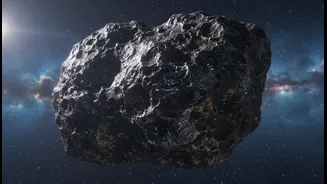
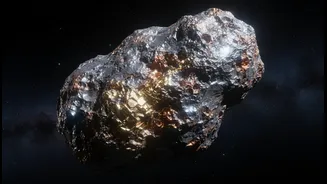
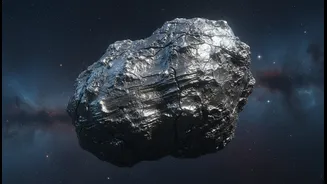
The “planet building blocks” scientists are searching for are known as planetesimals. According to the leading theory, after the sun formed, the surrounding disk of gas and dust began to clump together. Gravity pulled dust into pebbles, pebbles into rocks, and rocks into bodies several kilometres across called planetesimals. These objects are the seeds from which planets grow. Through a process called accretion, these planetesimals collided and stuck together, eventually forming the protoplanets that became Earth, Mars, and the cores of the gas giants. By studying the chemical makeup of Jupiter and Saturn, scientists can deduce the composition and distribution of these ancient building blocks.
Our Eyes on the Giants
Getting these clues requires sophisticated tools. NASA's Juno mission, which has been orbiting Jupiter since 2016, is our primary detective on the scene. Juno’s instruments map Jupiter’s gravity and magnetic fields to peer beneath the cloud tops and understand its internal structure. This data helps reveal whether Jupiter has a solid core and measures the amount of water and other heavy elements in its atmosphere — key indicators of how it formed. Beyond our own system, the James Webb Space Telescope (JWST) is revolutionizing the field by studying gas giants around other stars. Recent JWST observations of the HR 8799 system, for example, detected chemicals that support the core accretion model, suggesting even super-sized gas giants form like Jupiter did.
A New Picture of Planet Formation
The data coming back from these missions is already redrawing our understanding. For a long time, it was thought Jupiter might have a small, solid core. However, Juno's findings suggest Jupiter's core is surprisingly large, 'fuzzy,' and diluted, meaning its heavy elements are mixed into a larger-than-expected portion of the interior. This challenges simple formation models and suggests a more complex and chaotic beginning. Furthermore, studies now indicate that gas giants form much faster than previously believed, possibly within the first one to two million years of a star's life. Their rapid growth would have profoundly shaped the rest of the solar system, with Jupiter's immense gravity acting as a gatekeeper, influencing which materials were available to form the inner, rocky planets.
Why Giants Matter for a World Like Earth
The ultimate goal of studying gas giants is not just to understand them, but to complete the origin story of our own planet. The heavy elements that form the building blocks of life were delivered by icy planetesimals in the early solar system. Jupiter's composition and structure hold the key to understanding how these materials were distributed. Its gravitational influence was crucial, likely protecting the inner solar system from a constant barrage of cosmic debris while also shaping the orbits of the planets that did form. By figuring out how Jupiter came to be, we can create more accurate models of how a rocky planet like Earth could form in the 'habitable zone' and develop the necessary ingredients for life to emerge. Every secret Juno and JWST unlock from these distant giants brings us one step closer to understanding our own cosmic history.