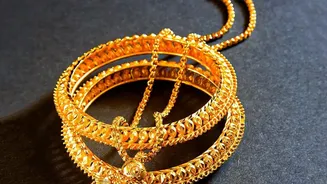







The Base Price of Gold
The first component of your bill is the price of gold itself. This price fluctuates daily based on market forces. Jewellers typically display the rate for 24-karat (99.9% pure) and 22-karat (91.6% pure) gold. Since 24K gold is too soft for intricate jewellery,
most pieces are made from 22K gold, which is an alloy mixed with other metals for durability. The price on your bill should be calculated based on the grammage and the 22K or 18K rate for that day. Always confirm the day's rate and the purity of the gold before you proceed. The final price of your jewellery is calculated based on its weight multiplied by the gold rate for that specific purity.
Making Charges: The Cost of Craftsmanship
Making charges are the fees for turning raw gold into a beautiful piece of jewellery. This cost covers the labour of the artisans, from designing and casting to polishing and finishing. These charges can be calculated in two main ways: as a fixed rate per gram of gold or as a percentage of the gold's value. This fee can range from as low as 5% for simple, machine-made items to over 25% for complex, handcrafted designs. It's important to know that making charges are often the most negotiable part of the bill. Don’t hesitate to ask for a discount, especially during festive seasons or if you are a repeat customer. Comparing making charges between different jewellers for a similar piece can lead to significant savings.
Wastage or Value Addition (VA)
Often a source of confusion, 'wastage' or 'Value Addition' (VA) is another charge you'll find on the bill. This fee accounts for the small amount of gold that is lost during the manufacturing process. When artisans cut, file, or polish the metal, tiny particles become unrecoverable. Jewellers pass this cost onto the consumer, typically as a percentage of the gold's weight, which can range from 3% to 7% for 22K gold. For highly intricate or antique-style jewellery, this percentage can be even higher. Some jewellers combine making charges and wastage into a single 'VA' figure. While some wastage is unavoidable, this charge is less transparent than making charges and can sometimes be inflated. Always ask for a clear breakdown.
Goods and Services Tax (GST)
The final price of gold jewellery includes a mandatory tax component. In India, the Goods and Services Tax (GST) is applied to your purchase. A 3% GST is levied on the total value of the gold plus the making charges. Additionally, some jewellers may show a separate 5% GST specifically on the making charges if they are billed as a separate line item. This is a non-negotiable government tax, but it's crucial to ensure it is calculated correctly on the final invoice. When you buy jewellery, this 3% tax is an added cost that you cannot recover if you decide to sell the piece later.
Hallmarking: Your Guarantee of Purity
One small charge that is absolutely worth it is for hallmarking. The Bureau of Indian Standards (BIS) hallmark is a certification that guarantees the purity of the gold you are buying. It is now mandatory for jewellers in India to sell hallmarked gold jewellery. A hallmarked piece will have the triangular BIS logo, the karat purity (e.g., 22K916), and a six-digit alphanumeric Hallmark Unique Identification (HUID) number. This assures you that you are getting the purity you paid for and protects you from being sold lower-purity gold at a higher price. The hallmarking charge is nominal and provides essential peace of mind for your investment.
Stones and Buy-Back Policies
If your jewellery includes precious or semi-precious stones, their value is calculated separately and added to the total bill. Remember that when you sell or exchange the jewellery, the full value of the stones is rarely recovered. Similarly, the making charges and GST you paid are not refunded in a buy-back transaction. Most jewellers' buy-back policies offer you the value of the gold at the prevailing market rate on the day of sale, after deducting these costs. Before making a purchase, it's wise to inquire about the jeweller's specific exchange and buy-back terms.