





The Ghost in the Machine
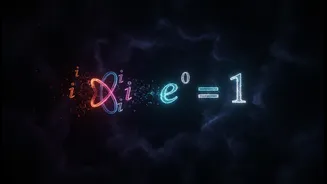
For almost a century, one of the fundamental building blocks of quantum theory has been a mathematical concept that doesn’t technically exist in the real world: imaginary numbers. Specifically, the number 'i', or the square root of -1, has been a cornerstone
of the equations that describe the strange behaviour of subatomic particles. Physicists like Erwin Schrödinger built their descriptions of quantum states, called wave functions, using these 'complex numbers' (a combination of a real and an imaginary number). This mathematical framework has been incredibly successful, forming the basis for technologies like lasers, microchips, and the emerging field of quantum computing. For decades, the debate has simmered: are complex numbers a true feature of nature, or just a convenient shortcut for calculation?
Challenging a Century of Physics
A groundbreaking new study from physicists at Heinrich Heine University Düsseldorf and the German Aerospace Center (DLR) provides a startling answer: quantum mechanics can work perfectly well without imaginary numbers. Published in the journal Physical Review Letters, their work presents the first working model of quantum mechanics using only 'real' numbers—the kind we use every day. This directly challenges previous work, including a notable 2021 study which concluded that complex numbers were essential and unavoidable. That earlier conclusion, however, relied on a specific mathematical assumption about how to combine two separate quantum systems. The new research found a way around this roadblock.
A New Rule for Reality
The key to this breakthrough was rethinking a fundamental rule called the 'tensor product', which is the standard textbook method for mathematically describing a combined system of multiple particles. Past attempts to build a real-number version of quantum theory using this rule failed because they couldn't reproduce the results of experiments involving entanglement between three or more particles. The team led by doctoral researcher Pedro Barrios Hita developed an alternative rule. Their new approach is built on a different, more intuitive idea: an action performed on one part of a system should not have any effect on a separate, unlinked part of it. By replacing the restrictive tensor product with this new, physically motivated postulate, they successfully built a theory based entirely on real numbers that makes the exact same predictions as standard quantum mechanics for any experiment imaginable.
Why This Changes Our Understanding
This discovery forces a major re-evaluation of what constitutes the fundamental 'building blocks' of quantum theory. It suggests that complex numbers are not an indispensable feature of reality, but rather a highly convenient mathematical tool. Professor Dagmar Bruß, a leader on the research team, explained that within their new framework, imaginary numbers are not fundamentally necessary and can be replaced. This doesn't mean physicists will stop using complex numbers, as they are often a massive simplification for complex calculations. But it does mean that the underlying reality they describe may be simpler than previously thought. It peels back a layer of mathematical abstraction, bringing us closer to understanding the core principles that truly govern the universe at its most fundamental level.
From Abstract to Application
While this seems like a highly abstract debate, simplifying the foundational rules of quantum mechanics could have long-term practical implications. A deeper, more intuitive understanding of the theory's core principles could accelerate innovation in quantum technologies. Fields like quantum computing and quantum communication rely on manipulating uniquely quantum effects like superposition and entanglement. By providing a new, simpler language to describe these phenomena, this research could potentially open new avenues for designing quantum algorithms or even developing new types of quantum devices. It reminds us that even after a hundred years, the most basic questions about our quantum world can still lead to revolutionary new insights.