
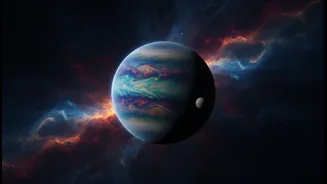


A Proven Planet-Hunting Pro
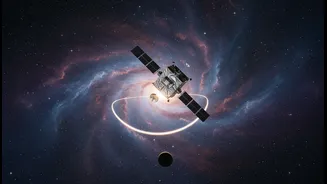
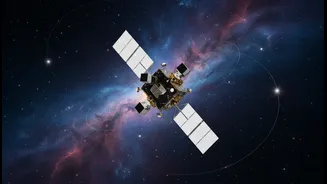
Launched in 2018, the Transiting Exoplanet Survey Satellite (TESS) was designed with a specific job: find planets outside our solar system, or exoplanets. For years, it has excelled at this by using the 'transit method'. TESS stares intently at stars,
watching for a tell-tale dip in their brightness. This dimming often means a planet has passed in front of its star from our point of view. This technique is especially good at finding large, gaseous planets that orbit very close to their stars, as they cause a significant and repeating dip in light. To date, TESS has identified thousands of potential exoplanets this way, with hundreds confirmed, completely changing our map of the nearby cosmos.
What Is the 'Einstein Era'?
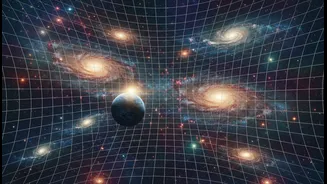
The 'Einstein Era' refers to a powerful new capability for TESS: using a phenomenon called gravitational microlensing. This effect was first predicted by Albert Einstein in his 1915 theory of general relativity. The theory describes how massive objects warp the fabric of spacetime. Gravitational microlensing occurs when a foreground star, along with its potential planets, passes almost perfectly in front of a much more distant background star. The gravity of the foreground star acts like a magnifying glass, bending and focusing the light from the background star, causing it to appear temporarily brighter. It's a cosmic alignment that gives astronomers a new way to 'see' the invisible.
Bending Light to Find New Worlds
Instead of looking for a star dimming, scientists are now looking for a star brightening. If the foreground star acting as a lens has a planet orbiting it, that planet's own gravity adds a smaller, secondary distortion to the magnified light. This creates a unique signature in the brightening event—a brief, extra flicker that tells astronomers a planet is there. In a first for the mission, TESS successfully used this technique to help confirm a planet named Gaia23bra b. Initial hints of the event were spotted by the European Space Agency's Gaia telescope in 2023, but TESS’s more continuous observations of that same sky patch were crucial in revealing the planet's signature.
A Different Kind of Planet
This new method completely changes the game for TESS. The transit method is biased towards finding planets close to their stars and relatively nearby, typically within about 150 light-years. Gravitational microlensing is different. It can find planets that are much farther away and in much wider orbits, similar to Jupiter's distance from our sun. The first planet found this way, Gaia23bra b, is a gas giant about 1.6 times the mass of Jupiter, orbiting a star nearly 40,000 light-years away—a distance that would make it impossible to detect via the transit method. This technique is sensitive enough to find smaller, even Earth-mass planets, in cooler, more distant orbits.
A Preview of Future Discoveries
The successful use of microlensing was an unexpected bonus for the TESS mission; nobody thought it would be capable of this kind of discovery when it launched. It proves that a wealth of new information may be hiding in the eight years of data TESS has already collected. This discovery serves as a preview for what's to come from NASA’s Nancy Grace Roman Space Telescope, set to launch in late 2026. Roman's primary mission will use microlensing to survey the dense center of our galaxy, but TESS can uniquely apply the technique to other, less crowded parts of the sky. By combining these methods, astronomers get a more complete census of the planets in our galaxy, from the hot, close-in worlds to the cooler, distant ones that might be more like our own.