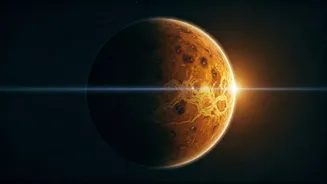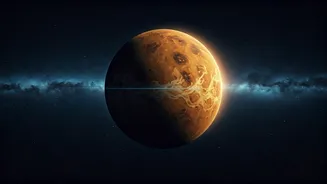







A Day That Outlasts a Year
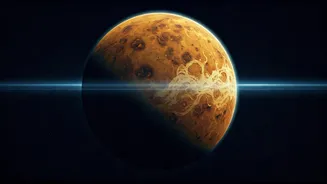
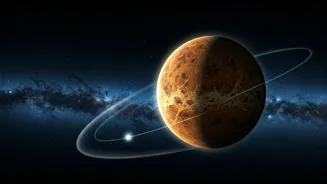
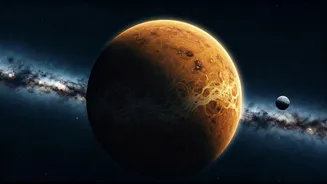
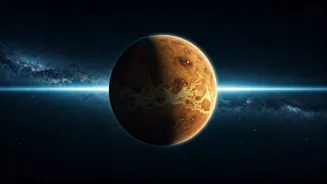
On Earth, our sense of time is simple: the planet spins once on its axis to give us a day, and it orbits the Sun to give us a year. We get about 365 days in every year. But Venus throws this entire concept out the window. A year on Venus—the time it takes
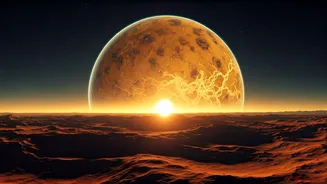
to complete one full orbit around the Sun—is roughly 225 Earth days. Here’s the mind-bending part: it takes Venus a whopping 243 Earth days to complete just one rotation on its axis. This means a single Venusian day is 18 Earth days longer than an entire Venusian year. If you could stand on its surface, you would see the Sun rise, crawl across the sky with agonizing slowness, and set, but by the time it rose again, the planet would have already completed its trip around the Sun and then some.
Spinning the Wrong Way
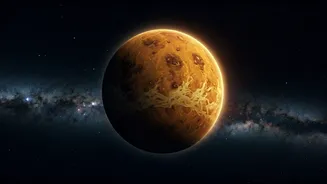
As if a day longer than a year wasn't strange enough, Venus also spins backwards. Most planets in our solar system, including Earth, rotate on their axis in a counter-clockwise direction (prograde motion). This means the Sun rises in the east and sets in the west. Venus, however, spins clockwise. This phenomenon, known as retrograde rotation, means that if you were on Venus, you'd watch the Sun rise in the west and set in the east. Only one other major planet, Uranus (which is tilted on its side), shares this odd characteristic. This backward, sluggish spin makes Venus one of the true oddballs of the solar system, a planet that stubbornly refuses to follow the rules.
Why Is Venus So Slow and Backwards?
Scientists don't have a single, definitive answer for Venus's peculiar rotation, but there are several leading theories. One popular hypothesis involves a colossal impact early in the solar system's history. It's possible that a massive, planet-sized object smashed into Venus billions of years ago, altering its spin and either dramatically slowing it down or completely reversing it. Another compelling theory points to Venus's incredibly thick, heavy atmosphere. The dense blanket of carbon dioxide, 90 times thicker than Earth's, creates powerful atmospheric tides. Over billions of years, the gravitational pull of the Sun on this dense atmosphere could have acted like a brake, slowing the planet's rotation to its current crawl. This atmospheric drag, combined with friction between the atmosphere and the solid planet, might be enough to explain both the slow speed and the retrograde direction.
A World of Extreme Consequences
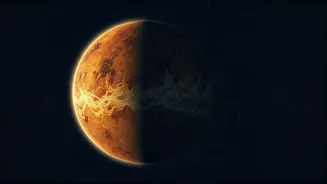
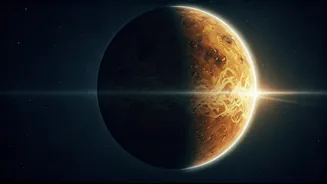
This incredibly long day has profound effects on Venus, contributing to its status as the most inhospitable planet in our solar system. With the Sun beating down on one side of the planet for months at a time, surface temperatures soar to a staggering 465 degrees Celsius—hot enough to melt lead. This extreme heat is trapped by the thick, runaway greenhouse effect of its atmosphere. While you might expect the 'night' side to be frozen, the dense atmosphere is remarkably efficient at circulating this heat. As a result, there is very little temperature difference between the day and night sides. The entire planet is a perpetual, sweltering furnace. The slow rotation means there are no familiar day-night cycles, just an endless, scorching 'day' that lasts for months, followed by an equally scorching 'night'.