



A New Life for a Distant Pioneer
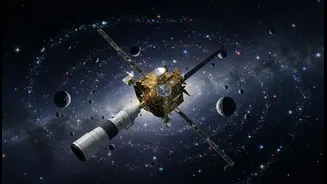
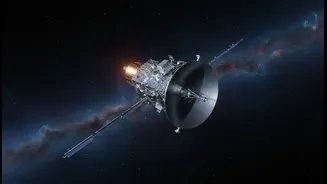
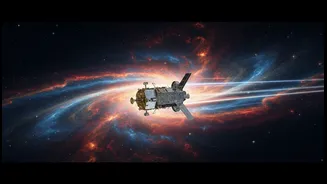
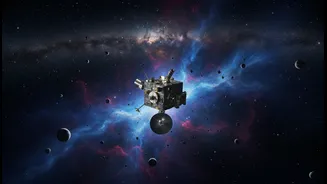
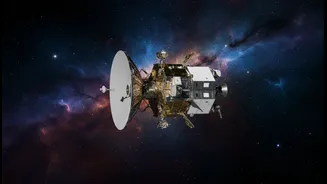
Launched in 2006, the New Horizons probe is a triumph of engineering, famous for its historic flyby of Pluto in 2015 that transformed our understanding of the dwarf planet. After that success, it continued deeper into the cosmos, studying a Kuiper Belt
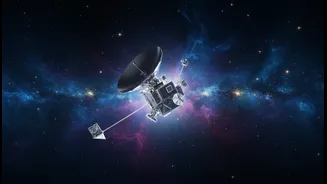
object named Arrokoth in 2019. Now, billions of kilometres from home, the spacecraft has been roused from a lengthy hibernation for a new purpose. Its mission has been extended, and its powerful ultraviolet imaging spectrograph, an instrument named Alice, is being repurposed to stare into the void. This isn't just about saving resources by reusing old tech; it's about using the probe's unique position to do science that is impossible from anywhere closer to home.
The Universe's Unexplained Glow
A long-standing puzzle in cosmology is the simple question: just how dark is space? While the night sky appears black, it’s not perfectly dark. For decades, astronomers have detected a faint, uniform glow in ultraviolet light, known as the cosmic ultraviolet background (CUVB). After subtracting the light from all known stars and galaxies, there’s still more light than our models can explain. Theories for its origin have ranged from the summed light of countless unseen dwarf galaxies to more exotic ideas like the decay of hypothetical cosmic particles. The problem with measuring it from Earth, or even from near-Earth orbit with telescopes like Hubble, is contamination. Our inner solar system is filled with dust that reflects sunlight, creating a pervasive glow called zodiacal light which drowns out the faint CUVB.
A Unique Vantage Point
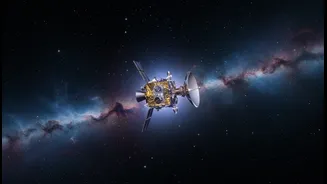
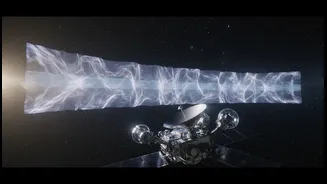
This is where New Horizons comes in. Now over 9.5 billion kilometres away, it is far beyond the distorting haze of the inner solar system's dust. This gives it the darkest, clearest view of the universe any spacecraft has ever had. The Alice instrument, originally designed to analyse the composition of Pluto's thin atmosphere, is a spectrograph. A spectrograph acts like a cosmic prism, breaking down light into its constituent wavelengths. Each element and molecule has a light 'fingerprint', allowing scientists to determine the composition, temperature, and motion of distant objects. By turning Alice towards the blackness between stars, scientists can measure this background glow with unprecedented precision, free from the interference that has hampered all previous attempts.
Rewriting the Cosmic Rules
The re-activation of Alice for this purpose fundamentally refines the framework for deep-universe spectroscopy. For years, cosmological models have relied on assumptions and extrapolations to account for the CUVB. These assumptions influence our understanding of everything from the total number of galaxies in the universe to the processes of star formation over cosmic history. Early results from New Horizons have already challenged previous estimates, suggesting the universe might be less crowded with faint galaxies than some models predicted. By getting a clean measurement, New Horizons provides a solid baseline—a true zero-point for the background light of the cosmos. This allows astronomers to calibrate their models with real-world data, not just theory. It constrains the 'light budget' of the universe, forcing a re-evaluation of how many stars and galaxies have ever been created.