




The Old Myth of a 'Dead' Planet
For a long time, planetary scientists held a straightforward assumption: a planet without significant liquid water or a thick atmosphere must be geologically “dead.” On Earth, much of the landscape is shaped by water, from rivers carving canyons to glaciers
grinding down mountains. Wind plays a role, but our thick atmosphere and water cycle are the dominant forces. It was logical to assume that on a dry world with a thin atmosphere, like Mars or the even more distant Pluto, the surface would be a static, frozen museum, preserving ancient impact craters for eternity with little to no new activity. This picture suggested that without the key ingredients for Earth-like weather and geology, these planets were essentially dormant.
Whispers of Wind in the Sand
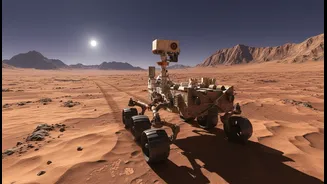
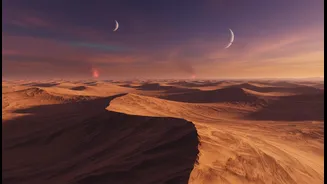
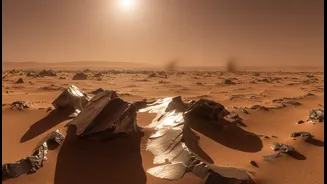
The first clues that this assumption was wrong came in the form of dunes. Dunes are simple in principle. They require just two things: a supply of small, loose particles—like sand or ice—and a force to move them, typically wind. When orbiters first spotted dune fields on Mars, it was a revelation. These were not just static relics; observations over time have shown that Martian dunes are actively migrating. This proves that even in Mars's incredibly thin atmosphere, which has less than 1% the pressure of Earth's, winds are strong enough to kick up grains and reshape the landscape. These moving dunes are a definitive sign of aeolian processes, or wind-driven activity, showing that the Red Planet is far from still.
A Surprising Discovery on Pluto
The most stunning evidence came from the edge of our solar system. When NASA's New Horizons spacecraft flew by Pluto in 2015, it discovered something astonishing: dunes made not of sand, but of frozen methane ice. Pluto is an unimaginably cold world with an atmosphere 100,000 times thinner than Earth's. So how could it possibly have winds strong enough to form dunes? The answer lies in a process called sublimation, where a solid turns directly into a gas. On Pluto, solid nitrogen ice on the surface is warmed slightly by the faint sun, turning into nitrogen gas. This outgassing can be energetic enough to lift tiny grains of methane ice into the wispy atmosphere, where even gentle winds can carry them along. This discovery proved that even on the most frigid, low-pressure worlds, complex atmospheric and geological interactions can occur.
Redefining a 'Living' Planet
The presence of active dunes on Mars and Pluto forces us to broaden our definition of a geologically active planet. Activity isn't limited to dramatic volcanism or the grinding of tectonic plates. It can also be driven by the subtle interplay between sunlight, ice, and a tenuous atmosphere. On Mars, seasonal changes cause carbon dioxide frost at the poles to sublimate, which boosts atmospheric pressure and drives winds that move sand. On Pluto, it’s nitrogen sublimation that kicks methane grains into motion. These worlds might be dry in the traditional sense, lacking the liquid water that defines so much of Earth's geology, but they are very much alive with their own unique environmental processes. The dunes are the storytellers, recording the direction and strength of winds and offering a window into the current climate of these alien landscapes.