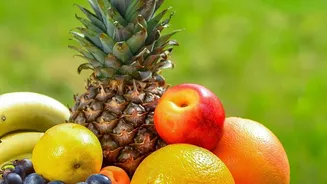







Choosing between sweet, juicy fruits like pineapple and pear can feel like a tough decision. Both are delicious and packed with goodness, but they offer surprisingly different nutritional profiles. Let's break down what each brings to the table.
A Quick Calorie and Carb Check
When comparing
fruits, it's helpful to look at a standard 100-gram serving. In this regard, pineapple and pear are quite similar. Pineapple contains around 50 calories, while pear has slightly more at about 57 calories. Both are very low in fat and protein, with their energy coming almost entirely from carbohydrates. Their sugar content is also nearly identical, but how your body processes that sugar is a different story.
The Vitamin C Powerhouse: Pineapple
If you're looking to boost your immune system, pineapple is the clear winner. It is an excellent source of Vitamin C, a powerful antioxidant that helps protect your cells from damage and supports immune function. A 100-gram serving of pineapple can provide over 50% of your daily recommended intake of Vitamin C, whereas the same amount of pear offers a much smaller fraction. Pineapple also provides a significant amount of manganese, a mineral crucial for bone health and metabolism.
The Fiber Champion: Pear
Pears truly shine when it comes to dietary fiber. A single pear can contain around 6 grams of fiber, which is a significant portion of your daily needs. This includes both soluble and insoluble fiber, which are essential for digestive health. Fiber helps maintain bowel regularity, promotes a feeling of fullness to aid in weight management, and feeds the beneficial bacteria in your gut. For the same serving size, pear contains more than double the fiber of pineapple. For the maximum benefit, be sure to eat the pear's skin, which is packed with extra fiber and antioxidants.
Pineapple's Secret Weapon: Bromelain
Pineapple contains a unique enzyme mixture called bromelain, which is not found in pears. Concentrated mostly in the core and stem, bromelain is known for its ability to break down proteins, which is why it's a great natural meat tenderizer. Medically, it has been studied for its anti_inflammatory properties, potentially helping to reduce swelling and pain associated with injuries and conditions like osteoarthritis. It is also thought to aid digestion and may help with sinus congestion. While eating the fruit provides some bromelain, much of the research is based on concentrated supplements.
Pear's Antioxidant Profile
While pineapple has its unique enzyme, pears boast a rich profile of flavonoid antioxidants, especially in their skin. These compounds, including quercetin and anthocyanins (in red_skinned varieties), help fight inflammation and protect the body from oxidative stress, which is linked to chronic diseases like heart disease. Pears are also a good source of potassium and copper, minerals that support heart health and iron absorption, respectively.
Blood Sugar Impact
For those monitoring their blood sugar, the glycemic index (GI) is an important factor. The GI measures how quickly a food raises blood sugar levels. Pears have a low GI, typically around 38, meaning they cause a slower, more gradual rise in blood sugar. Pineapple, on the other hand, has a medium GI, often cited as 59 or higher, which can lead to a quicker spike. The high fiber content in pears helps to slow down sugar absorption, making it a more favourable choice for blood sugar management.