


Our Crowded Cosmic Backyard
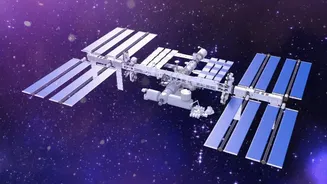
Low Earth Orbit (LEO) is an incredibly valuable resource, home to thousands of satellites that power everything from your phone’s GPS to global internet services and weather forecasts. But decades of space activity have left behind a dangerous legacy:
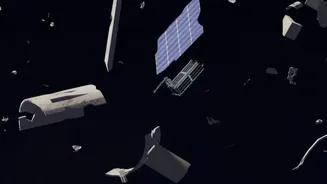
space junk. According to the European Space Agency, there are over 36,000 pieces of debris larger than a softball being tracked, and millions of smaller, untraceable fragments. This junk includes defunct satellites, spent rocket stages, and shards from past collisions, all whipping around the planet at speeds exceeding 17,000 miles per hour. At that velocity, even a tiny paint fleck can strike with the force of a grenade, capable of disabling a critical satellite. The ultimate fear is the Kessler Syndrome, a theoretical cascade where one collision creates debris that causes more collisions, eventually rendering entire orbits unusable.
A High-Tech Space Cleanup
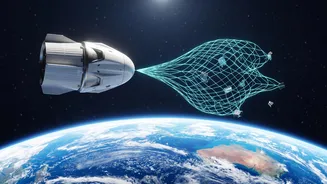
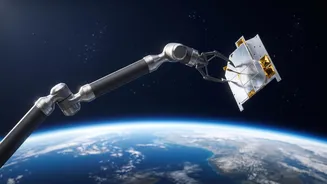
The headline-grabbing idea of a “laser harpoon” combines two distinct but promising technologies. Harpoons are indeed being tested as a way to capture large, tumbling pieces of debris. The RemoveDEBRIS mission, led by the University of Surrey and involving Airbus, successfully demonstrated firing a harpoon to spear a target panel in orbit. The appeal of the harpoon is its simplicity and speed; it can secure a target quickly without needing to match its spin perfectly. Alongside harpoons, engineers are developing other capture methods, including giant nets, robotic arms, and even gecko-inspired adhesives that can stick to a variety of surfaces. The European Space Agency's upcoming ClearSpace-1 mission, for example, will use a four-armed robotic claw to grab and de-orbit a piece of a rocket.
The Real Role of Lasers
So, where do the lasers come in? While not typically combined with harpoons, laser technology plays two key roles. First, advanced guidance systems, such as LiDAR (Light Detection and Ranging), are crucial for allowing a chaser satellite to safely approach, map, and target a piece of debris before attempting a capture with a harpoon or claw. Second, lasers are being developed as a capture method in their own right, but not to grab junk. Instead, a technique called laser ablation uses a powerful beam to vaporize a tiny part of a debris object's surface. This creates a small puff of plasma that acts like a micro-thruster, gently nudging the object into a new, less dangerous trajectory or pushing it toward an orbit where it will burn up in Earth's atmosphere faster.
The Emerging Cleanup Market
This isn't just a science experiment; it's the foundation of a new commercial industry. Companies are racing to offer what's being called Active Debris Removal (ADR) or even "Debris Removal as a Service." Japanese firm Astroscale is a market leader, having tested magnetic docking systems and recently patented a multi-object removal architecture where a "servicer" spacecraft hands off debris to a "shepherd" vehicle for final disposal. This would allow a single mission to clear multiple large objects, dramatically improving cost-efficiency. Meanwhile, Swiss startup ClearSpace SA's contract with ESA for the ClearSpace-1 mission, scheduled for 2028, is a major government endorsement of the need for these commercial solutions. These pioneers are betting that orbital cleanup will soon be as essential as launching satellites in the first place.
Challenges on the Final Frontier
While the technology is advancing rapidly, significant hurdles remain. Active debris removal is technically complex, expensive, and fraught with legal questions. For instance, who is liable if a cleanup mission accidentally damages a functioning satellite or creates more debris? International agreements on who can touch—or harpoon—an object owned by another country are still being worked out. Furthermore, the business case relies on convincing satellite operators to pay for cleanup services, either directly or through insurance and regulations. Despite these challenges, there is a growing consensus that doing nothing is not an option. The continued growth of satellite constellations for internet and communications makes a solution more urgent than ever.