


The Cosmic Detective's Toolkit
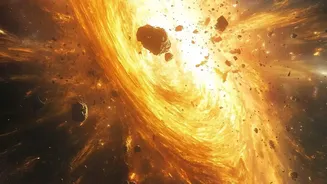
When a star explodes, it releases an immense amount of light and energy that travels across the universe. Astronomers act like cosmic detectives, gathering clues from this light to piece together the story of the star's death. Their primary tools involve
analysing the light's properties. One key method is creating a 'light curve', which is a graph that plots the supernova's brightness over time. The shape of this curve—how quickly it brightens and then fades—helps classify the type of supernova. A sharp peak followed by a gradual decline often points to one type of explosion, while a curve with a longer-lasting 'plateau' suggests another.
Decoding Light with Spectroscopy
Another powerful technique is spectroscopy, which involves splitting the supernova's light into its constituent colours, much like a prism creates a rainbow. This spectrum is not a smooth, continuous band of colour; it is crossed by dark and bright lines. These lines are chemical fingerprints, revealing the elements present in the exploding star's debris. For example, the presence or absence of hydrogen is a fundamental clue that helps divide supernovae into major categories: Type II supernovae have hydrogen, while Type I do not. By studying these spectral fingerprints, astronomers can determine the composition, temperature, and velocity of the material blasted into space.
A 'New Star' Appears in 1604
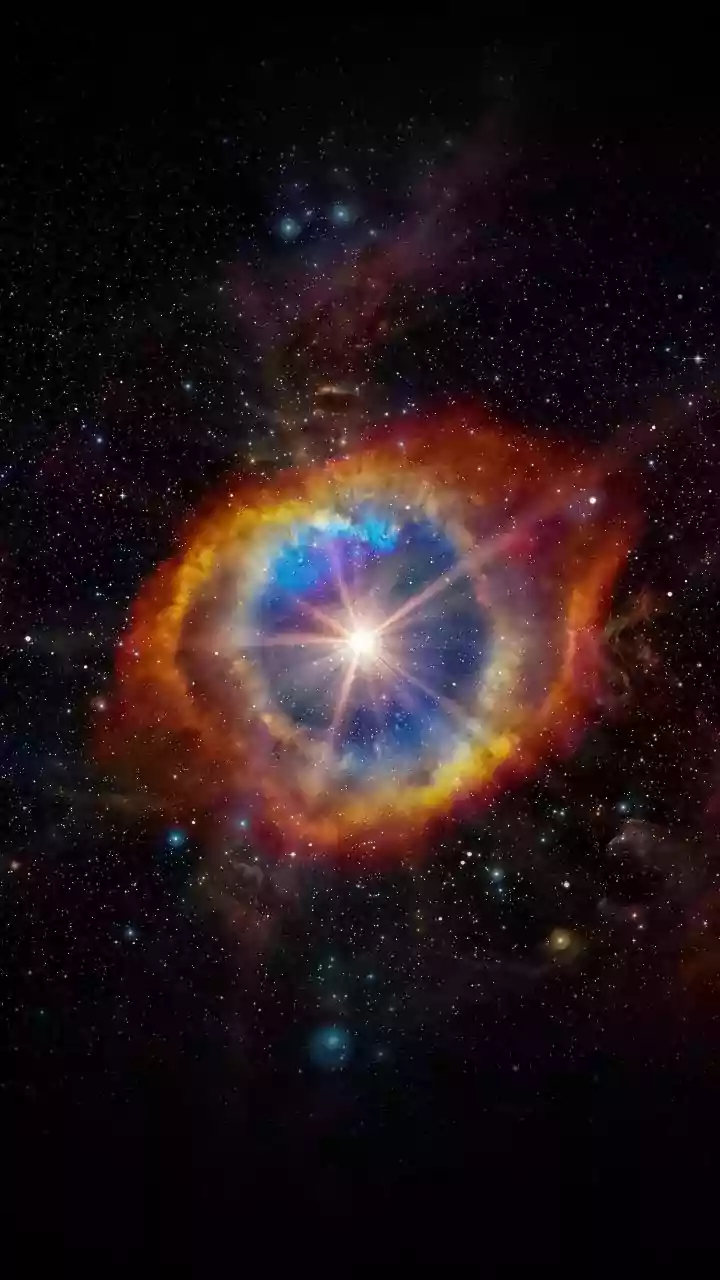
In October 1604, skygazers across Europe, China, and Korea noticed a brilliant 'new star' in the constellation Ophiuchus. It grew so bright it was visible during the day for over three weeks and outshone every star in the night sky. The German astronomer Johannes Kepler observed it extensively for a year, and his detailed account, 'De Stella Nova' (On the New Star), led to the event being named Kepler's Supernova. At the time, the heavens were believed to be perfect and unchanging. This event, along with another supernova seen in 1572, provided powerful evidence that the cosmos was, in fact, a dynamic and evolving place.
Revisiting the Crime Scene Centuries Later
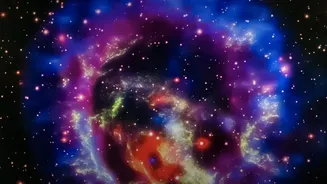
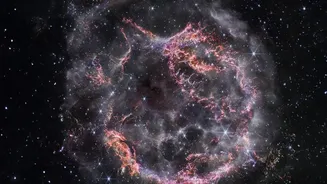
For centuries, the story of SN 1604 was limited to these historical accounts. But with modern telescopes, astronomers can revisit the scene of the explosion. In 1941, they discovered a faint, expanding cloud of gas and dust at the location Kepler recorded—the supernova remnant. Today, powerful observatories like NASA's Chandra X-ray Observatory, the Hubble Space Telescope, and the Spitzer Space Telescope study this remnant across different wavelengths of light, from X-rays to infrared. These multi-wavelength observations reveal details invisible to the human eye, showing the structure of the ejected material and how it interacts with the surrounding interstellar gas.
Solving the Mystery of Kepler's Star
By applying modern analytical techniques to the remnant of SN 1604, astronomers have determined it was a Type Ia supernova. This occurs when a dense, dead star called a white dwarf, part of a binary star system, siphons too much material from its companion star. This added mass triggers a runaway thermonuclear explosion. The evidence lies in the chemical composition of the remnant, which lacks the high oxygen abundance expected from a massive star's collapse, and the historical light curve, which matches the profile of a Type Ia event. These types of supernovae are incredibly important in astronomy because they have a predictable peak brightness, allowing them to be used as 'standard candles' to measure vast cosmic distances.