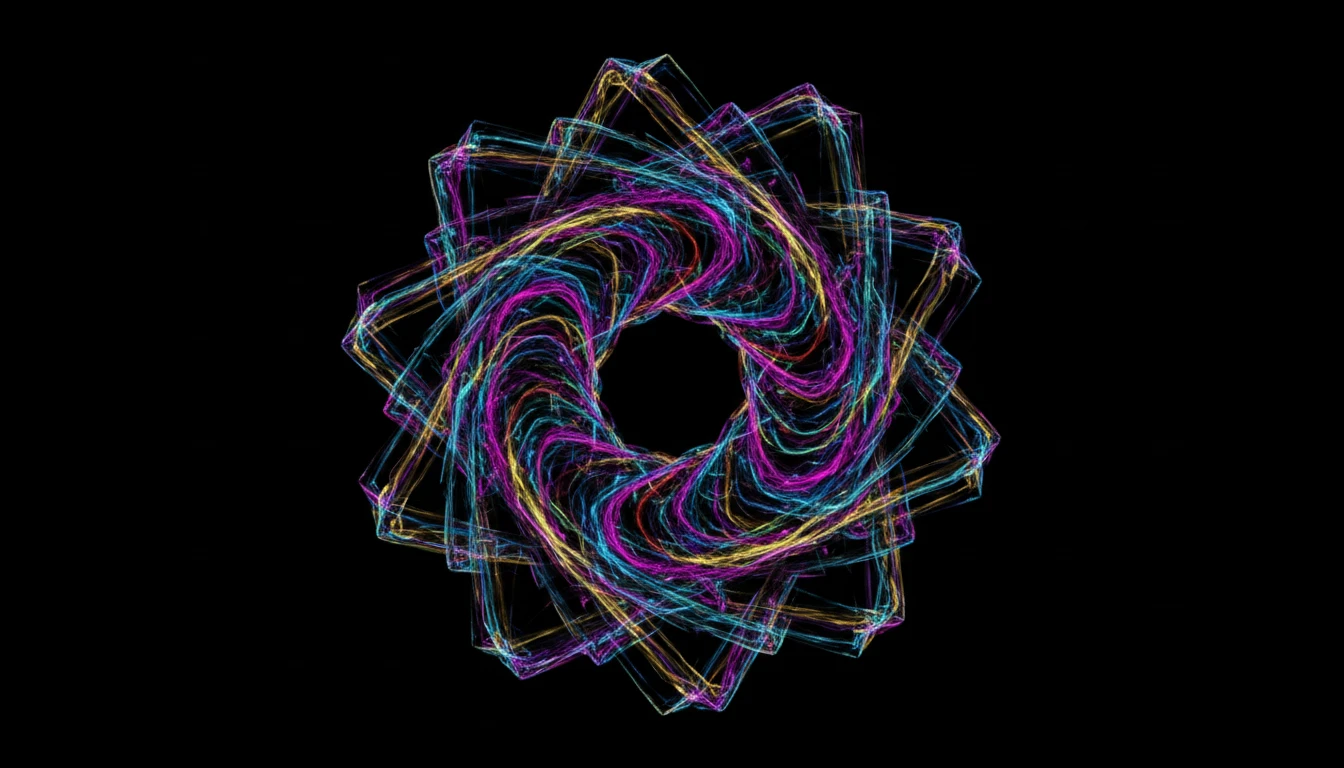









What Exactly Is an Optical Skyrmion?
First conceptualized in the 1960s for particle physics, skyrmions are incredibly stable, self-contained patterns that resist being disturbed. Think of them as tiny, robust whirlpools or knots. Only recently have scientists been able to create these structures
using light, giving birth to the 'optical skyrmion'. Imagine sculpting light itself into a swirling pattern of polarization so durable it behaves almost like a particle. These light-based knots are fascinating because their topological nature makes them remarkably stable; they don't easily unravel or lose their shape, which is a crucial property for carrying information.
The Promise for Future Computers
The excitement around optical skyrmions stems from their potential to completely overhaul computing and data systems. Current electronics rely on the flow of electrons, which generates heat and has physical size limitations. By using particles of light (photons) organized into skyrmions, we could create components that are significantly faster, smaller, and more energy-efficient. Their stability makes them ideal candidates for representing bits of data (the 1s and 0s of computing). Because they are topologically protected, they are highly resistant to noise and external disturbances that can corrupt data in current systems. This could lead to ultra-high-density data storage and processing power that would make today's supercomputers look quaint, accelerating everything from artificial intelligence to quantum computing.
A Leap in Data Storage and Transfer
Beyond just processing, optical skyrmions could transform how we store and move information. Unlike magnetic skyrmions, which are tied to a material surface, optical skyrmions can propagate through free space. This opens the door to light-speed communication between components, chips, and even entire systems, eliminating bottlenecks. Information could be encoded into the unique structure of each skyrmion, allowing for incredibly high data density. Researchers envision a future where vast amounts of data are stored in light patterns, dramatically reducing the physical footprint and energy consumption of the massive data centers that power our digital world.
The Reality Check: Still in the Lab
Despite the immense potential, it's crucial to understand that this technology is in its infancy. For all the promise, creating, controlling, and reading optical skyrmions is an immense scientific challenge. Most of the work is happening on a small scale in highly controlled laboratory settings. While recent breakthroughs have shown it's possible to generate skyrmions more simply than before—for instance, by shining a laser at a small disc—scaling this up into a reliable, mass-producible computing system is a monumental task. Researchers are still working on fundamental problems, like how to reliably manipulate these light structures and integrate them with other electronic components. The journey from a fundamental discovery to a commercial product is a long one, and optical skyrmions are just starting out.