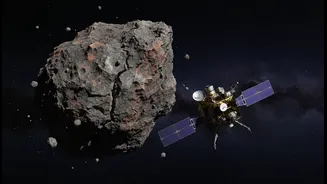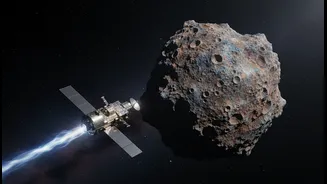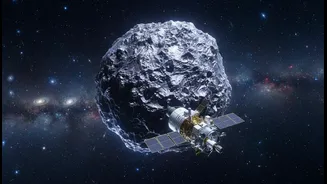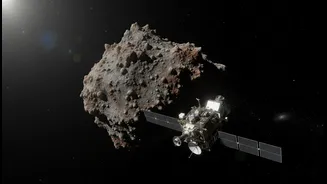





An Encore for a Legendary Spacecraft
First, let's give credit where it's due. The Hayabusa2 spacecraft, operated by the Japan Aerospace Exploration Agency (JAXA), is already a legend. In 2020, it successfully returned precious samples from the asteroid Ryugu to Earth, providing scientists
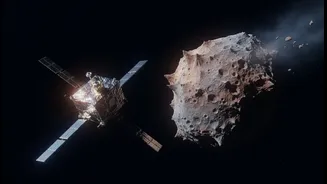
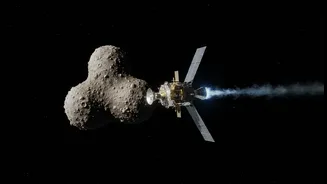
with a pristine look at the building blocks of our solar system. Most missions would end there, but with about half its xenon fuel remaining, JAXA sent Hayabusa2 on a new, incredibly ambitious extended mission. This recent event on July 5, 2026, was the first major milestone of that new journey: a high-speed pass of an asteroid named Torifune.
The Torifune Flyby in Focus
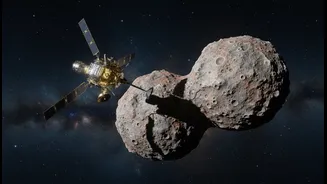
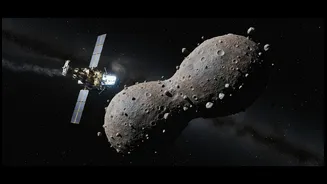
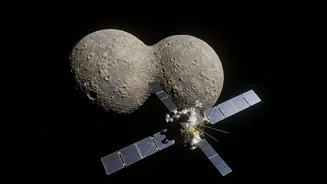
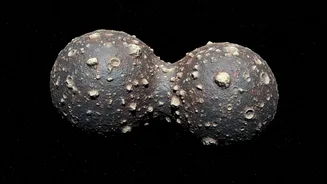
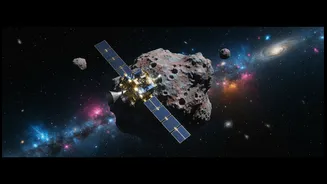
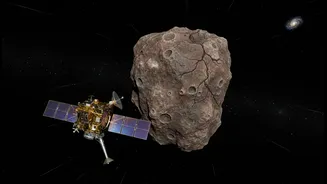
The flyby itself was a stunning technical achievement. Hayabusa2 screamed past Torifune at a relative speed of about 18,000 kilometres per hour. For the first time, we have close-up images of this 450-metre, stony S-type asteroid, revealing it to be a "contact binary"—essentially two separate asteroids that collided gently and stuck together, looking something like a snowman. The name Torifune itself, chosen from a public contest in Japan, refers to a mythical ship that travels as fast as a bird but remains as steady as a rock—a fitting name for this speedy space rock. This encounter was a crucial test of high-speed navigation, vital for future planetary defense missions where quickly assessing a potential threat is key.
A Stepping Stone, Not the Destination
Here's where the context becomes critical. While the images from Torifune are fascinating, this flyby was primarily a dress rehearsal. It was an operational test and a data-gathering stop on the way to an even more challenging and scientifically intriguing target. The ultimate goal of Hayabusa2's extended mission is a rendezvous in 2031 with a tiny, fast-spinning asteroid named 1998 KY26. Unlike the high-speed pass of Torifune, the plan is to actually meet up with and orbit this much smaller object. That's where the most groundbreaking science of this new mission phase will happen.
The Real Prize: 1998 KY26
So why all the effort to reach 1998 KY26? Because it represents a completely different class of celestial object. Recent observations have revealed it's much smaller and faster-spinning than first thought—only about 11 metres wide with a day that lasts just five minutes. Its gravity is so weak that the centrifugal force from its spin is stronger, creating a bizarre physical environment. Visiting it will be the first time a spacecraft has ever explored such a small, rapidly rotating body. Understanding how these 'micro-asteroids' are held together has massive implications for planetary science and, crucially, for planetary defense. An object this size is too small to be easily tracked from Earth but large enough to cause significant damage if it hit, similar in scale to the object that exploded over Chelyabinsk, Russia, in 2013.
From Hype to Hope
This is why simply hyping the Torifune flyby misses the bigger picture. It celebrates the single firework but ignores the entire display. The true wonder of Hayabusa2's journey isn't just about snapping pictures of another space rock. It's about pushing the boundaries of what's possible with a spacecraft that wasn't even designed for this task, on a mission that gets progressively more difficult. The flyby was a high-stakes test of the navigation skills needed to approach a target whose orbit isn't perfectly known until the last few days. The data gathered helps scientists practice for a real-life scenario where they might need to intercept a hazardous asteroid.