



An Unexpected Contaminant
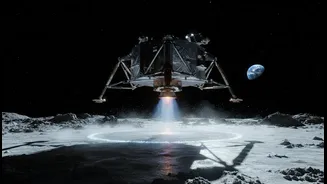
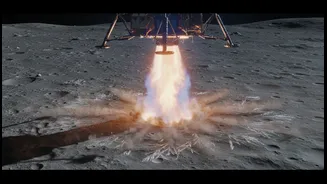
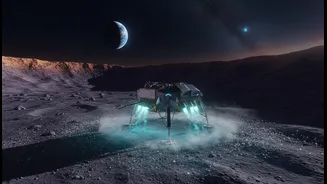
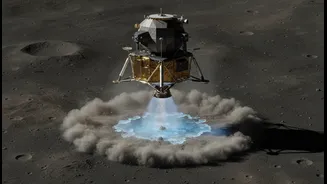
When we envision exploring the Moon, we often think of the dramatic moment of landing: the descent, the dust cloud, and the touchdown. But what happens after the engines cut off is proving to be just as consequential. Recent studies and simulations are
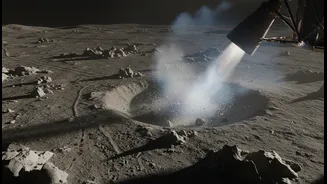
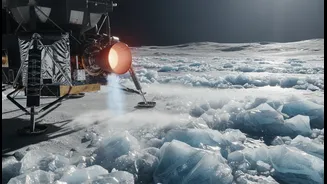
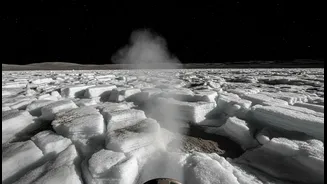
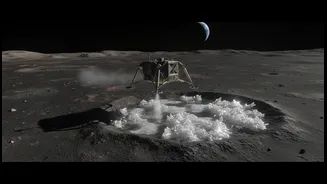
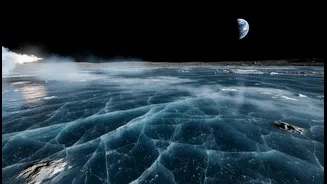
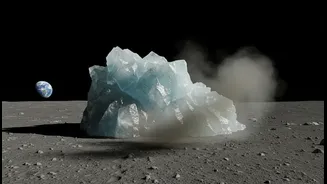
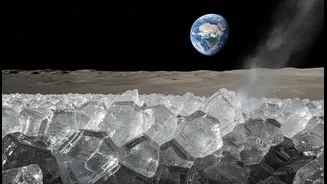
revealing a critical, and previously underestimated, side effect of landing on the Moon: contamination from the lander’s own rocket exhaust. For decades, scientists have dreamed of studying the pristine water ice locked away in the Moon's permanently shadowed craters near the poles. This ancient ice could be a time capsule, holding clues to the origins of water in our solar system and perhaps even the building blocks of life. However, new research shows that the very act of landing can threaten this precious resource. Computer models, some using data from missions like China's Chang'e-5, show that rocket exhaust—which contains significant amounts of water vapor and other chemical compounds like methane—doesn’t just dissipate. Instead, these molecules can travel vast distances across the airless lunar surface, eventually settling in the same cold traps that hold the ancient ice.
How Exhaust Spreads Across the Moon
On Earth, an atmosphere slows down and disperses exhaust fumes. The Moon has virtually no atmosphere, which means molecules travel in a completely different way. When a lander fires its engines, the exhaust gases aren't contained; they shoot out and begin a 'ballistic' journey, hopping across the surface. Simulations run by researchers at institutions like the Johns Hopkins Applied Physics Laboratory show that exhaust from a single mid-sized lander near the south pole can spread globally in a matter of hours or days. Within a couple of months, a significant percentage—up to 40% of the water vapor from the exhaust—can persist, with a large fraction freezing out and accumulating in the polar craters. This means a landing site on one side of the Moon could contaminate a scientifically vital research area on the other. The problem is not just water vapor covering native water ice; other propellant byproducts like methane can also spread and become trapped, confusing future scientific analysis.
The Double-Edged Sword for Science
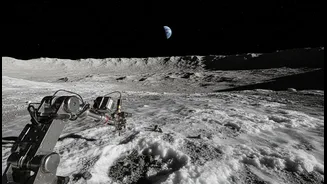
This discovery presents a difficult paradox. On one hand, the exhaust is a contaminant that could permanently alter the very environments scientists want to study. Finding molecules from Earth-made propellants mixed in with billions-of-years-old ice would be like trying to read an ancient manuscript with ink spilled all over it. This could jeopardize one of the primary goals of the Artemis missions and other international efforts: to understand the history and distribution of lunar volatiles. On the other hand, some instruments, like those planned for the Intuitive Machines landers, are designed specifically to study the interaction between the plume and the lunar soil (regolith). Understanding how exhaust kicks up dust and alters the surface is crucial for ensuring the safety of future, larger landers and any nearby habitats or equipment. The Apollo 12 mission, for example, famously sandblasted the nearby Surveyor 3 probe during its landing. As landers get bigger, the risk of damage from high-velocity dust and rocks increases dramatically.
Rewriting the Rules for a New Lunar Era
This growing awareness is forcing space agencies and international bodies to reconsider the rules of the road for lunar exploration. Planetary protection protocols have long existed to prevent biological contamination, but the focus is now shifting to include chemical and physical contamination. The Artemis Accords, a set of principles for cooperation in lunar exploration, already include commitments to preserve historic sites and mitigate debris. However, the exhaust issue requires more specific guidelines. Scientists are calling for contamination to be a routine part of mission planning. This could mean establishing 'quiet zones' around scientifically sensitive areas, designing new trajectories that minimize ground disturbance, or even developing 'greener' propellant technologies. NASA has already updated some of its planetary protection rules, designating the permanently shadowed regions as sensitive locations that require special precautions. Future mission planning will likely involve detailed modeling to predict where exhaust will travel and settle, allowing scientists to distinguish between native materials and human-introduced contaminants.