






Meet the Roman Space Telescope
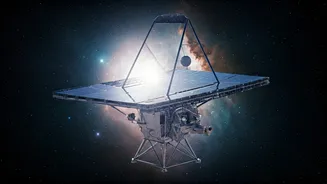
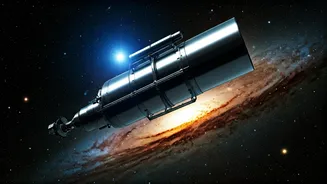
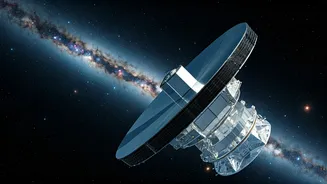
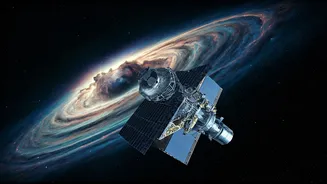
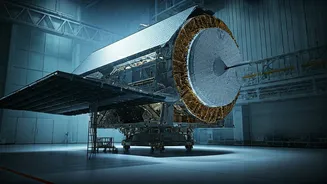
NASA's next great observatory is the Nancy Grace Roman Space Telescope, named after the agency's first chief astronomer, who is often called the 'Mother of Hubble'. This flagship mission is the next major infrared space telescope after the James Webb
Space Telescope (JWST). Having completed its assembly and testing at NASA's Goddard Space Flight Center, the telescope arrived at the Kennedy Space Center in Florida on June 21, 2026, for its final launch preparations. It is now targeted for launch no earlier than August 30, 2026, aboard a SpaceX Falcon Heavy rocket, a date that is eight months ahead of its original schedule.
A Panoramic View of the Universe
While Roman has a primary mirror that is 2.4 meters (7.9 feet) in diameter—the same size as Hubble's—its key advantage is its immense field of view. Its Wide Field Instrument (WFI) will be able to capture an area of the sky at least 100 times larger than Hubble can in a single image. This means a single picture from Roman will contain the equivalent detail of 100 Hubble images. This incredible survey capability will allow Roman to map huge swathes of the sky with unprecedented speed and efficiency. What might take Hubble thousands of years to observe, Roman could accomplish in just one. It will generate a staggering 1.4 terabytes of data daily.
Hunting for Dark Energy and New Worlds
Roman's mission is focused on tackling two of the most profound questions in modern astronomy: understanding dark energy and discovering exoplanets. To investigate dark energy, the mysterious force causing the universe's expansion to accelerate, Roman will map the distribution of hundreds of millions of galaxies and observe thousands of supernovae. Its second primary goal is to complete a census of planetary systems by using a technique called gravitational microlensing. This method allows it to detect exoplanets, including rogue planets that drift through space untethered to a star. In addition to its main surveys, the Roman telescope also features a Coronagraph Instrument, a technology demonstrator designed to directly image giant exoplanets by blocking the overwhelming light from their host stars.
A Spy's Eye on the Cosmos
The Roman Space Telescope has a unique origin story. The core of the observatory is a 2.4-meter primary mirror that was originally built for a different purpose and was donated to NASA by the National Reconnaissance Office (NRO), the U.S. agency responsible for spy satellites. This pre-existing hardware gave the mission a significant head start. While built to look down at Earth, the mirror was perfectly suited for looking out into the cosmos, forming the foundation of this powerful new astronomical tool.
A Powerful Partner to James Webb
Roman is not a replacement for JWST but a powerful complement to it. While both are infrared observatories, they have different strengths. JWST is designed for deep, narrow-field observations, peering back to the very dawn of the universe with incredible sensitivity. Roman, by contrast, is a survey instrument designed for speed and breadth. It will act as a cosmic scout, identifying countless new targets—from distant galaxies to nearby exoplanets—that JWST and other telescopes can then study in greater detail. While Roman finds the cosmic wonders, Webb can follow up with its focused gaze to unlock their secrets. Together, they will provide a more complete picture of the universe, from its earliest moments to its ongoing evolution.