
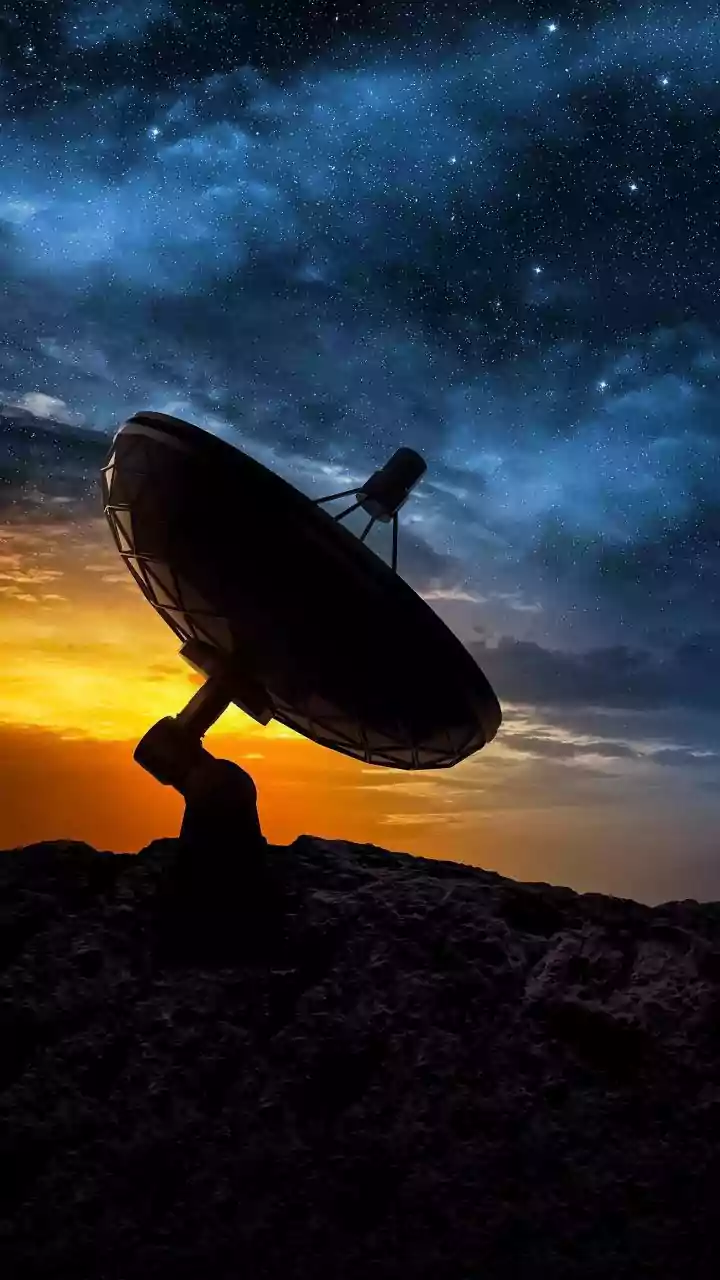





What is the Square Kilometre Array?
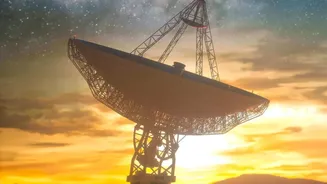
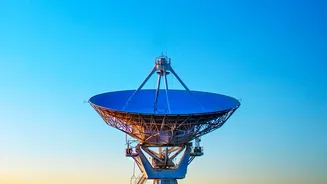
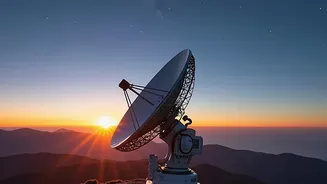
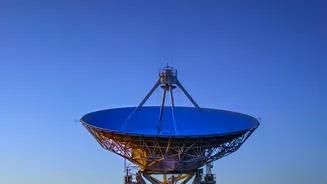
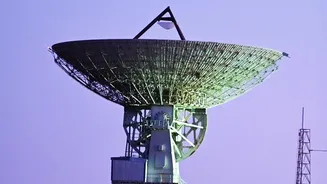
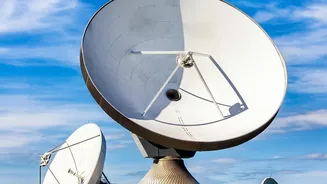
The Square Kilometre Array (SKA) is not a single telescope but a gigantic, multi-national effort to build the world's largest and most sensitive radio telescope. The project is so vast that it's split across two continents. In South Africa's Karoo region,
an array of up to 200 dish antennas (known as SKA-Mid) will be built. Meanwhile, in the remote desert of Western Australia, over 131,000 Christmas tree-like antennas (SKA-Low) will be installed. When combined, they will function as one colossal observatory, with headquarters in the UK, designed to detect faint radio signals from the depths of space and time. The name comes from the original goal of creating a total collecting area of one square kilometre.
Tuning Into the Universe’s Oldest Radio Show
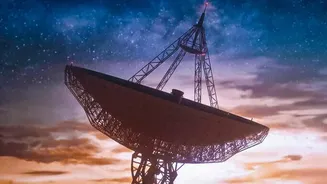
To see the early universe, astronomers can't rely on optical telescopes like the Hubble. The light from the first stars has travelled for billions of years across the expanding universe, and this journey stretches its wavelength. Visible light becomes infrared, and eventually, the most ancient signals are stretched into low-frequency radio waves. This is where the SKA comes in. It is designed to listen to these incredibly faint, ancient radio signals. One of its primary targets is the '21-cm line'—a specific radio frequency emitted by neutral hydrogen gas. This gas was the most abundant substance in the universe before the first stars and galaxies ignited and filled the cosmos with light. By tuning into this signal, the SKA can create a 3D map of the universe as it was during its infancy.
Why Size and Numbers Are Everything
The headline's 'massive arrays' are the key to the SKA's power. In radio astronomy, sensitivity (the ability to detect faint signals) and resolution (the ability to see fine details) are critical. You can achieve this by building a single, impossibly large dish, or by using a technique called interferometry. Interferometry links many smaller antennas together and combines their data with a supercomputer. The distance between the furthest antennas in the array effectively determines the 'size' of the telescope. For the SKA, these antennas will be spread over tens or even hundreds of kilometres. This huge separation gives the SKA extraordinary resolution, allowing it to see the universe in high definition. The sheer number of antennas provides a massive collective 'bucket' to catch the faint radio whispers from the cosmic dawn, making it 50 times more sensitive than any previous radio telescope.
Mapping the ‘Epoch of Reionisation’
One of the SKA's most profound goals is to map a period known as the 'Epoch of Reionisation'. After the Big Bang, the universe was dark and filled with neutral hydrogen gas. This era is often called the Cosmic Dark Ages. Eventually, the first stars and galaxies formed, and their intense radiation began to ionise the surrounding hydrogen gas, like billions of tiny lamps clearing away a cosmic fog. This transition was not instantaneous but a complex process that lasted hundreds of millions of years. The SKA-Low telescope in Australia is specifically designed to detect the faint signals from the neutral hydrogen just before and during this transformation. By creating 3D maps of these hydrogen structures over time, scientists can essentially watch a movie of how the first galaxies were born and how they reshaped the entire universe.
A Global Effort for Cosmic Answers
Building such a monumental instrument is beyond the capability of any single nation. The SKA is a truly global collaboration, involving over a dozen member countries, including India. In early 2024, the Indian government approved a commitment of ₹1,250 crore for its participation, paving the way for full membership in the SKA Observatory. Indian scientists and engineers, led by the National Centre for Radio Astrophysics (NCRA) in Pune, have been integral to the project from its early days, particularly in developing the Telescope Manager—the complex software or 'neural network' that will control the entire observatory. This international cooperation not only pools financial resources and technical expertise but also ensures that this incredible scientific tool will be available to astronomers from around the world, promising a new golden age of discovery.