

Catching Starlight Through an Atmosphere
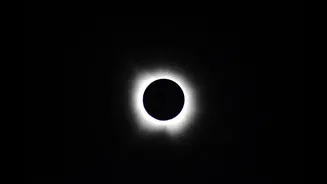
The primary technique JWST uses is called transmission spectroscopy. It’s a clever method that relies on a specific cosmic alignment. Scientists wait for an exoplanet to transit, or pass in front of its host star from our point of view. As this happens,
a tiny fraction of the starlight filters through the planet's atmosphere before it continues its journey to the telescope’s mirrors. That filtered light carries the secrets of the world it just skimmed past. While the planet itself blocks a lot of light, the thin halo of its atmosphere leaves a faint, but readable, imprint on the light that gets through.
Reading a Chemical Barcode
Think of the star's light as a full rainbow of colors. When that light passes through an exoplanet’s atmosphere, different gas molecules absorb very specific colors, or wavelengths, of light. Water vapor will absorb certain shades, methane will absorb others, and so on. This creates a unique pattern of missing colors in the starlight's spectrum—a pattern that functions like a chemical barcode. By analysing which “bars” are missing from the light spectrum after it passes through the atmosphere, astronomers can determine precisely which gases are present. JWST's powerful spectrographs are exquisitely designed to read these incredibly faint barcodes from trillions of kilometres away.
From a Gaseous Sky to a Liquid Ocean
So, how does knowing about the air tell us about the water? The connection is based on fundamental physics and chemistry. If a planet’s atmosphere is found to be saturated with water vapor, it strongly implies the existence of a vast reservoir of liquid water on the surface below. An atmosphere rich in water vapor suggests an active water cycle, where water evaporates from an ocean, forms clouds, and returns as rain, just like on Earth. This is the central idea behind the concept of 'Hycean' worlds—hypothetical planets covered by deep, global oceans with hydrogen-rich atmospheres. The detection of methane and carbon dioxide alongside water vapor, as seen on planets like K2-18b, further strengthens the case for a water world with complex atmospheric and potentially oceanic chemistry.
The Ultimate Goal: Searching for Life
Detecting water is one thing, but JWST’s mission goes a step further: the search for biosignatures. These are gases that, on Earth, are only produced by living organisms. One of the most talked-about biosignatures is a molecule called dimethyl sulfide (DMS). On our planet, DMS is overwhelmingly produced by marine life like phytoplankton. Finding it in an exoplanet's atmosphere would be a monumental discovery. Recently, JWST has found tentative, though not yet conclusive, evidence of DMS in the atmosphere of K2-18b, a potential Hycean world located 124 light-years from us. While scientists remain cautious and are seeking more data, this tantalising clue represents one of the most promising signs of potential biological activity found outside our solar system to date.
Putting the Puzzle Together
A single chemical detection is not enough. The final step involves sophisticated computer modelling. Scientists take the data from JWST—the presence and abundance of molecules like water, methane, and CO2—and feed it into models that simulate the planet’s climate and atmospheric physics. These models help them rule out non-biological origins for certain chemicals and build a more complete picture of the exoplanet. Is the temperature right for liquid water? Is the atmospheric pressure suitable? By combining direct observation with powerful simulations, astronomers can move from simply listing the ingredients of an atmosphere to truly characterising an entire world, assessing its habitability and decoding the chemistry of its hidden oceans.