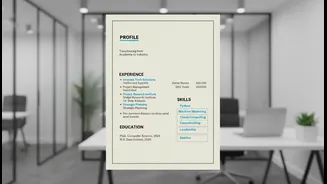









Deconstruct, Don't Discard Your CV
The first step in transitioning to industry is not to delete your academic achievements, but to see them through a new lens. Your academic Curriculum Vitae (CV) is a comprehensive record of your skills and accomplishments. It's an inventory of everything
you've done, from managing long-term research projects to presenting complex data. Instead of viewing it as a document for professors, see it as raw material. The challenge isn't a lack of experience; it's a problem of translation. Industry hiring managers scan resumes for specific keywords and quantifiable impacts, something academic CVs aren't designed for. Your goal is to deconstruct this inventory and rebuild it into a concise, powerful marketing document that speaks the language of business.
Translate Publications into Project Management
Every research paper you've published is proof of your project management skills. Think about it: you defined a problem, designed a methodology, managed timelines, coordinated with co-authors or lab members, analysed data, and delivered a final product. In industry terms, this is a completed project. Instead of just listing a publication title, reframe it as an achievement. For example: "Managed a two-year research project from conception to publication, coordinating with a team of three to deliver findings on schedule." This shows initiative, leadership, and the ability to see a complex task through to completion—all highly valued skills in the corporate world.
Reframe Teaching as High-Level Communication
Your experience as a teaching assistant or guest lecturer is far more than an academic duty. It's concrete evidence of your communication and leadership abilities. You’ve taken complex, technical information and made it understandable to a non-expert audience. This is a critical skill in business, whether you're explaining a product to a client or presenting a strategy to senior management. On your resume, translate this experience into bullet points like: "Trained and mentored over 50 undergraduate students in advanced laboratory techniques," or "Developed and delivered weekly presentations on complex subjects, improving student comprehension scores by 15%." This demonstrates mentorship, public speaking, and the ability to educate stakeholders.
Quantify Your Research Impact
In academia, the 'what' of your research is paramount. In industry, the 'so what' is what gets you hired. Recruiters want to see the impact of your work, and the easiest way to show this is with numbers. Go through your CV and find every opportunity to quantify your accomplishments. Did you develop a new algorithm? By how much did it improve efficiency? Did you analyse a large dataset? How many data points did it contain? Did you secure funding? How much was the grant worth? Turning a statement like "Analysed cellular data" into "Analysed a dataset of over 1 million cells to identify three novel biomarkers" provides concrete evidence of scale and achievement that any hiring manager can appreciate.
Showcase Your Transferable Skills
A PhD is a rigorous training program in problem-solving, critical thinking, autonomy, and resilience. These so-called 'soft skills' are often the most difficult to teach and, therefore, the most valuable to employers. Your academic CV is filled with examples of these skills in action, even if they are not explicitly named. Working independently on a dissertation for years demonstrates immense self-discipline and time management. Troubleshooting a failed experiment shows problem-solving abilities. Navigating peer review demonstrates an ability to handle constructive criticism. Make these skills explicit. Create a 'Skills' section on your resume and list competencies like Data Analysis, Project Management, Critical Thinking, and Stakeholder Communication, all backed by the evidence in your experience section.