



A Sweet Discovery In The Stars
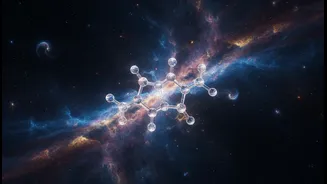
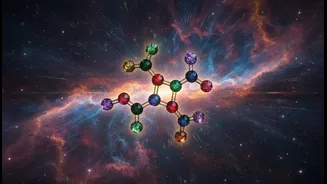
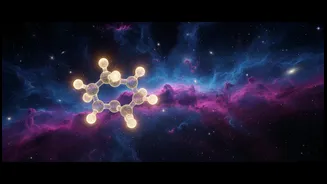
In the cosmic dust and gas clouds floating near the center of our Milky Way, astronomers have found something remarkable: a type of sugar. An international team of researchers detected the first true sugar molecule, called erythrulose, in a giant molecular
cloud more than 26,000 light-years from Earth. Sugars are a vital class of organic molecules, acting as energy sources and forming key components of DNA and RNA in life on our planet. While simpler molecules and even the components of sugars have been found in meteorites, this marks the first time a true, multi-carbon sugar has been directly identified in the interstellar medium—the raw material from which stars and planets are born.
How Astronomers Found It
You can't exactly visit a molecular cloud 26,000 light-years away. Instead, scientists become cosmic detectives, hunting for molecular fingerprints. The team, led by researchers from the Spanish National Research Council, used powerful radio telescopes in Spain to analyze the faint signals coming from the cloud G+0.693−0.027. Every molecule vibrates and rotates, emitting or absorbing radiation at very specific frequencies. By patiently observing the cloud, astronomers identified 12 distinct spectral lines that perfectly matched the laboratory signature of erythrulose, a four-carbon sugar also found in some fruits on Earth. This painstaking process of matching cosmic signals to lab data provides definitive proof of the molecule's presence among the stars.
Rewriting the Cosmic Cookbook
This discovery does more than just add another molecule to the growing list of over 270 found in space. It challenges a key theory about how complexity arises in the universe. For a long time, many scientists believed that large molecules formed incrementally, by adding one carbon atom at a time. However, the research team found that erythrulose, a four-carbon sugar, is significantly more abundant in the cloud than simpler three-carbon sugars. This surprising abundance suggests a different process is at play. The evidence points to erythrulose forming from the combination of two-carbon molecules on the icy surfaces of cosmic dust grains. It seems the universe has efficient shortcuts for creating the complex ingredients necessary for life.
A Head Start for Life
The presence of pre-made, complex organic molecules like erythrulose in a star-forming cloud has profound implications for the origin of life. It suggests that when new planetary systems form from clouds like this one, they are seeded from the very beginning with a rich inventory of life's building blocks. This idea of a cosmic 'starter kit' for life is gaining traction with numerous discoveries. Scientists have previously found other complex organics, like those related to alcohols and amino acids, in similar environments. The sheer abundance of erythrulose detected suggests that millions of tonnes of such sugars could have been delivered to a young Earth by comets and meteorites billions of years ago, providing a rich chemical soup from which life could emerge.
The Search Continues
The discovery of erythrulose is a major milestone, but it's also just the beginning. Researchers are now planning to search for even more complex sugars in space, including ribose, the five-carbon sugar that forms the backbone of RNA. Each new discovery helps piece together the chemical pathway from simple stardust to living organisms. Telescopes like the James Webb Space Telescope are providing unprecedented views into these chemical factories, revealing the intricate processes happening in the cradles of stars and planets. These findings bring us one step closer to answering one of humanity's oldest questions: are we alone in the universe? While this discovery isn't life itself, it confirms that the raw materials are scattered across the cosmos, waiting for the right conditions to come together.