



More Than Just a Pretty Picture
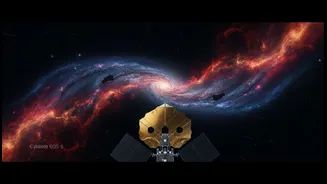
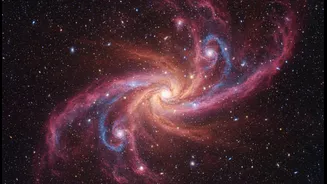
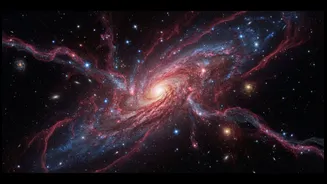
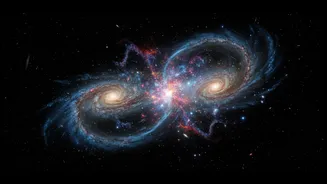
The breathtaking images of galactic mergers released by the James Webb Space Telescope are more than just cosmic art; they are dense layers of scientific data. Webb is designed to see the universe in infrared light, a spectrum invisible to the human eye.
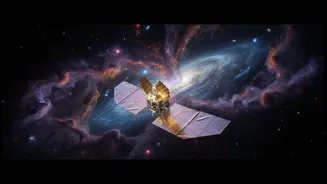
This is crucial because the most distant, ancient galaxies have their light stretched into the infrared by the expansion of the universe, and infrared light can also pierce through the thick veils of cosmic dust that obscure the most interesting parts of galactic collisions. But the telescope's genius lies in its ability to observe this light at multiple different infrared wavelengths using its suite of powerful instruments, like the Near-Infrared Camera (NIRCam) and the Mid-Infrared Instrument (MIRI). Each wavelength tells a different part of the story, and by combining them, scientists can construct a complete picture of these monumental events.
Peeling Back the Cosmic Layers
Think of multi-wavelength analysis as having a set of specialised glasses. Looking through one pair (near-infrared) might reveal the combined light of millions of individual stars, showing the underlying structure of the colliding galaxies. Another pair (mid-infrared) filters out that starlight and instead reveals the glow of heated dust. This allows scientists to see where new stars are being born inside dense gas clouds, a process that is often hidden. Longer wavelengths can even help pinpoint the intense energy pouring out from a supermassive black hole devouring matter at the galaxy's core. By switching between these views, astronomers can disentangle the complex processes happening simultaneously. They can see the galaxies' original spiral arms being twisted out of shape by gravity, while also seeing the tendrils connecting their cores where intense starbursts are taking place.
A Case Study: The Chaos of Arp 220
A perfect example of this technique in action is Webb's observation of Arp 220, a pair of colliding spiral galaxies located 250 million light-years away. Arp 220 is an ultra-luminous infrared galaxy (ULIRG), meaning it shines with the light of over a trillion suns, mostly in the infrared. For years, much of what was happening inside was hidden by dust. When Webb viewed it with NIRCam and MIRI, the picture became dramatically clearer. Webb's view revealed the two distinct cores of the original galaxies, each with a rotating ring of furious star formation. Combining the different infrared datasets, scientists could see faint tidal tails of material being pulled away from the galaxies, while also mapping streams of organic material within the central, chaotic region. This multi-wavelength view showed that the amount of gas in a tiny central region is equal to all the gas in our entire Milky Way galaxy, fueling an incredible burst of star formation.
The Symphony of Data
The real breakthrough is not in seeing these individual components, but in understanding how they connect. Multi-wavelength analysis allows scientists to create a unified model of the merger's dynamics. For instance, observations of the galaxy system II ZW 96, another merger viewed by Webb, showed how its instruments could resolve the bright cores and the tendrils of star-forming regions connecting them. This allows researchers to study how feedback from one process, like an active black hole, influences another, like star formation across the galaxy. It’s like listening to a symphony. One instrument (one wavelength) gives you the melody, another the rhythm. But only by hearing them all together can you appreciate the full composition and understand how the different parts interact to create the music. Webb allows astronomers to do this for galaxies, revealing how the interplay of gas, dust, stars, and black holes drives their evolution.