





Fueling a New Robotic Era
The significant $150 million Series A round was co-led by prominent venture capital firms Andreessen Horowitz (a16z) and F-Prime. This infusion of capital, which brings the company's valuation to a staggering $1.45 billion, is earmarked for scaling its
groundbreaking technology and accelerating customer deployments. A Series A funding round typically marks a crucial transition for a startup, moving from an initial concept to commercialization and growth. For Eka, it's a powerful endorsement of their vision to create robots that can perform complex, real-world tasks with superhuman efficiency. The funding will allow the company to expand its team, which already includes talent from leading research institutions and tech giants, and further develop its unique AI model.
From Fixed Motions to Physical Intuition
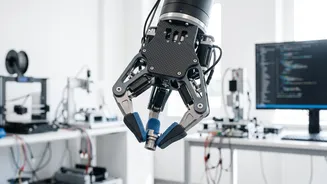
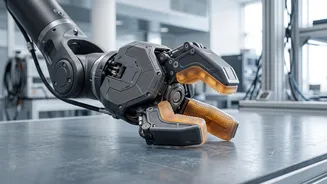
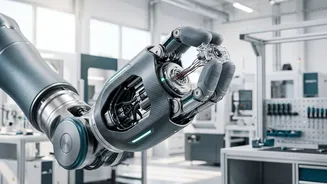
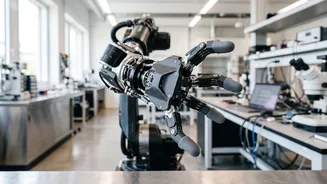
For decades, industrial robots have been powerful but unintelligent, confined to cages and programmed to repeat the exact same motion thousands of times. They excel at specific, predictable tasks on an assembly line but are useless if a part is misplaced or a new object is introduced. Eka Robotics aims to shatter this limitation. Their approach moves beyond simple programming to what they call a 'vision-force-action' (VFA) model. This AI system combines sight with a sense of touch, using reinforcement learning in simulated environments to build a physical 'intuition'. Instead of being told exactly how to move, the robots learn the physics of a task, allowing them to handle objects with a dexterity and adaptability that was previously impossible. This means a single robot can learn to handle delicate items like produce, or perform complex actions like screwing in a lightbulb or inserting wires.
Superhuman Speed and Adaptability
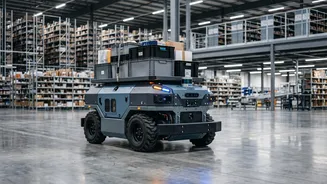
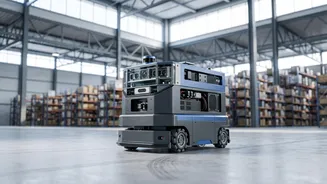
The performance of Eka's technology is already demonstrating its disruptive potential. Their robots can pick and place a wide variety of objects, even those they haven't been specifically trained on, at a rate of around 1,500 operations per hour. This is more than double the average human's speed of about 600 operations per hour for similar tasks. By training its AI model in simulation, Eka can generate thousands of hours of experience in just minutes, testing the robots against countless variables in objects, environments, and physical conditions. This ability to learn and adapt without human demonstration is key to creating truly general-purpose robots—machines that can be deployed in dynamic environments like warehouses, logistics hubs, and flexible manufacturing lines without constant reprogramming.
Implications for Indian Industry
While Eka Robotics is based in the U.S., its technological leap has profound implications for India's burgeoning industrial and manufacturing sectors. India's robotics market is in a phase of explosive growth, with a projected compound annual growth rate (CAGR) of over 15% to reach more than $7 billion by 2034. The country is already the seventh-largest market for annual robot installations globally, driven by sectors like automotive, electronics, and logistics. The advent of 'cobots' (collaborative robots) that can work alongside humans is already transforming factory floors. Eka’s technology represents the next step in this evolution: robots that are not just collaborative but truly intelligent. For a nation focused on initiatives like 'Make in India', this level of automation can enhance productivity, improve quality control, and increase global competitiveness without completely replacing the human workforce. Instead, it allows skilled workers to move to higher-value roles, overseeing and managing fleets of intelligent machines.