




Creating the Chillest Spot in the Universe
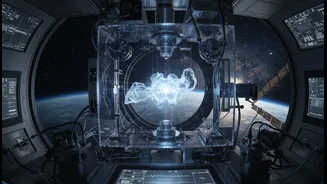
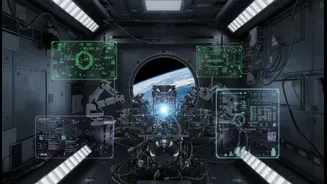
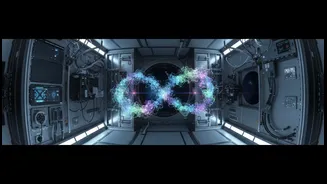
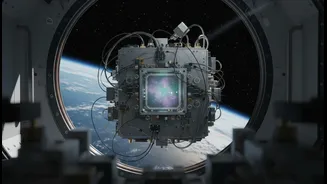
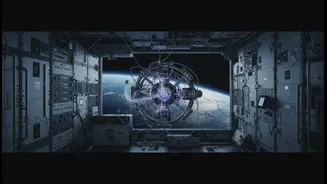
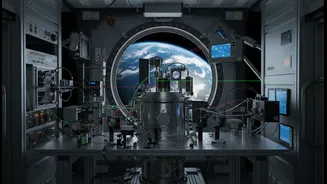
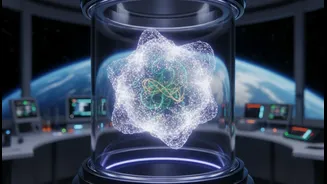
The primary mission of the Cold Atom Lab (CAL) is to study the behaviour of atoms at temperatures just a fraction of a degree above absolute zero, or –273.15 degrees Celsius. Nothing in nature is known to reach these temperatures. To get there, the lab
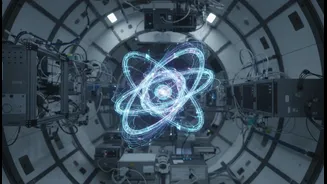
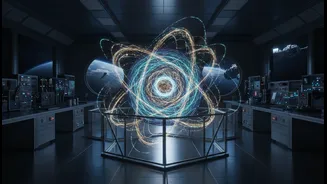
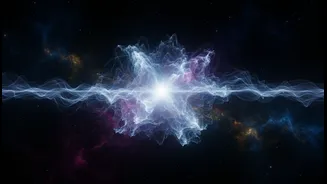
uses a sophisticated process of lasers and magnetic fields. First, lasers are fired at a cloud of atoms, such as rubidium or potassium, slowing them down and drastically reducing their temperature. Then, magnetic traps hold the atoms in place while other cooling techniques bring them to a near-standstill. At this point, something extraordinary happens: the atoms enter a fifth state of matter, predicted by Satyendra Nath Bose and Albert Einstein, called a Bose-Einstein Condensate (BEC). In a BEC, the individual atoms lose their distinct identities and behave like a single, massive quantum wave. This macroscopic quantum object allows scientists to observe behaviours that are usually confined to the subatomic realm.
Why Quantum Science Needs Microgravity
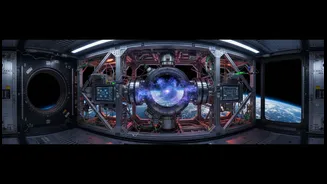
While scientists can create BECs in labs on Earth, gravity poses a significant problem. The delicate, ultra-cold atom clouds are pulled downwards, giving researchers only fractions of a second for observation before they dissipate. In the microgravity environment of the International Space Station, these limitations vanish. The BECs can float and expand for much longer, up to 10 seconds, allowing for more detailed study and reaching even colder temperatures than possible on the ground. This extended observation time is crucial for probing the fundamental laws of physics and exploring unknown quantum phenomena. Since its installation in 2018, the CAL has undergone several upgrades, with the most recent in 2026 enhancing its ability to manipulate these quantum gases, giving scientists unprecedented control to explore the nature of the universe.
From Abstract Physics to Precision Instruments
The strange properties of Bose-Einstein Condensates are not just a scientific curiosity; they are the foundation for a new generation of ultra-precise sensors. The wavelike nature of these atom clouds makes them incredibly sensitive to external forces like gravity, acceleration, and rotation. This is the principle behind atom interferometry, a technique that can measure these forces with unparalleled accuracy. By splitting a BEC, letting it interact with its environment, and then recombining it, scientists can detect minuscule variations. This capability opens the door to developing quantum sensors that could be orders of magnitude more sensitive than today's classical instruments. These advancements could revolutionize everything from deep-space navigation to how we monitor Earth's resources.
Informing Real Decisions for Space and Earth
The research conducted aboard the CAL is directly informing the development of technologies that will shape future decisions. For space exploration, this means next-generation atomic clocks for more accurate timekeeping and autonomous navigation where GPS is unavailable. It also means developing advanced gravity gradiometers—sensors that can map a planet's gravitational field from orbit with incredible detail. Such instruments could reveal the composition of distant planets, help find underground water reserves on Mars, or even aid in the search for mysterious dark matter. Back on Earth, the same principles could lead to sensors that monitor climate change by tracking polar ice mass, improve mineral exploration by detecting gravitational anomalies, or enable navigation in deep-sea environments. The CAL is not just a physics experiment; it's a testbed for the foundational technology of tomorrow's critical systems.