

Eyes on the Sky
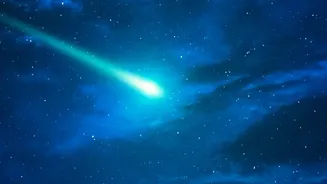
The first step in investigating a meteor is spotting it. While lucky stargazers are often the first witnesses, a more systematic approach comes from dedicated camera networks. Organisations like NASA operate all-sky camera systems, such as the All-sky
Fireball Network, with stations strategically placed to provide overlapping coverage of the night sky. These automated cameras are designed to detect fireballs—meteors that are brighter than the planet Venus—and record their fiery descent. By capturing the same event from multiple locations, astronomers can use triangulation to calculate the meteor's trajectory, speed, and altitude as it tears through the atmosphere. This data is crucial for the next steps of the investigation.
From Fireball to Dark Flight
A meteor's visible, burning phase is only part of its journey. If the original space rock, or meteoroid, is large enough, parts of it can survive the intense heat and pressure. After the fireball extinguishes, any surviving fragments continue to fall to the ground in what is called "dark flight." These pieces are no longer glowing and are now called meteorites. Tracking them becomes a new challenge, and for this, scientists often turn to an unlikely tool: weather radar. Powerful radar systems like the U.S. NEXRAD network can detect falling meteorites, allowing scientists to model their descent through the wind and pinpoint a likely landing zone, known as a strewn field.
The Hunt for Fallen Stars
With a predicted landing zone, the search for the meteorite begins. This can be a painstaking process of searching a specific area on foot. Deserts and icy landscapes like Antarctica are ideal hunting grounds because the dark, fusion-crusted rocks stand out against the plain background. Time is critical; the longer a meteorite is exposed to Earth's environment, the more it becomes contaminated and weathered by rain and oxygen, losing valuable scientific information. To speed up recovery, some research teams are now deploying modern technology, using drones and machine learning algorithms to scan large areas and identify potential meteorites from the air.
Secrets Written in Stone
Once a meteorite is recovered, the real laboratory work begins. Scientists slice off a small piece to study its internal structure and composition. Using powerful electron microscopes, they can identify the minerals and unique features within the rock. Techniques like mass spectroscopy are used to analyse the isotopes—different versions of elements—which help determine the meteorite's age and origin. Some meteorites, known as carbonaceous chondrites, contain materials that are over 4.5 billion years old, offering a pristine sample of the early solar system. This analysis is like reading a chemical fingerprint that tells the story of where the rock has been.
Tracing the Path Home
The final piece of the puzzle is to trace the meteorite's journey back to its parent body. By combining the trajectory data from the initial fireball observation with the compositional analysis from the lab, scientists can reconstruct the meteoroid's original orbit around the Sun. This allows them to determine if it came from the asteroid belt between Mars and Jupiter, which is the source of most meteorites, or perhaps even a more exotic location like the Moon or Mars. By linking specific types of meteorites back to their origins, astronomers build a map of our solar system, learning more about the formation of planets and the history of the cosmic neighbourhood we call home.