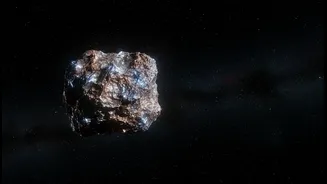









The Trillion-Dollar Prize in the Asteroid Belt
Located in the main asteroid belt between Mars and Jupiter, 16 Psyche is no ordinary space rock. Unlike most asteroids, which are primarily rock or ice, scientists believe Psyche is the exposed metallic core of an ancient protoplanet whose outer layers
were stripped away by collisions billions of years ago. Based on radar and spectral observations from Earth, it is thought to be composed largely of iron and nickel, along with significant quantities of platinum, gold, and other precious metals. While estimates of its total value are highly speculative—ranging up to $10,000 quadrillion—they serve to highlight the sheer scale of the resources it may hold. This staggering potential is what makes Psyche a focal point for the emerging field of space asset investment, representing a long-term, high-reward target.
Modeling the Mine, Not the Data
Since the NASA spacecraft only launched in October 2023 and won't send back detailed data from the asteroid until its arrival in 2029, investors aren't analyzing mission data directly. Instead, their work is about sophisticated financial modeling and risk assessment based on available information. This process involves using existing ground-based observations and analysis of metallic meteorites to create detailed projections of Psyche's composition. Financial analysts then build complex models to calculate the Net Present Value (NPV) of a potential future mining operation. This means estimating every conceivable cost—from research and development for new extraction technologies to launch costs, operational expenses in deep space, and the logistics of returning materials—and weighing them against the projected value of the recovered metals decades from now.
The High-Stakes Gamble on Technology and Time
For venture capitalists and specialized funds backing companies like AstroForge and TransAstra, this isn't a traditional investment. It's a long-duration bet on technological progress. Their analysis heavily factors in the declining costs of space launch, driven by companies like SpaceX, which fundamentally changes the economics of any future mission. They are funding the building blocks of the industry: startups developing low-cost spacecraft, autonomous robotics for extraction, and more efficient propulsion systems. The core belief is that the technology required for asteroid mining, while not fully mature, is on a predictable development curve. An investment today in a company developing asteroid prospecting tools is an early-stage entry into a supply chain that could, in 30 years, be servicing multi-trillion dollar extraction projects.
Navigating a Galaxy of Legal and Market Risks
Beyond the technical and financial hurdles, the biggest variable in any investment model for Psyche is regulatory risk. The 1967 Outer Space Treaty prohibits nations from claiming sovereignty over celestial bodies, creating ambiguity over ownership of extracted resources. While the United States' Commercial Space Launch Competitiveness Act of 2015 and the multi-national Artemis Accords assert the right of private entities to own what they mine, this framework is not universally accepted. Investors must price in this uncertainty. Furthermore, there's a significant market risk: successfully returning thousands of tons of platinum or gold from Psyche would likely crash commodity prices on Earth, making the valuation a moving target. Therefore, much of the initial focus is on in-space resource utilization (ISRU), like using water for propellant, which has a more contained and predictable market.