


First, Let's Define Our Terms
Before we dive into the temporal weirdness of Venus, let's get our basics straight. On Earth, a 'year' is the time it takes our planet to complete one full orbit around the Sun, roughly 365 days. A 'day' is the time it takes Earth to rotate once on its
axis, about 24 hours. These concepts seem simple enough, but Venus throws a cosmic wrench into the works. Its orbital period, or year, is significantly shorter than Earth's, while its rotational period, or day, is mind-bogglingly long.
A Swift Trip Around the Sun
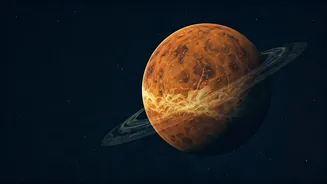
Venus is the second planet from the Sun, orbiting closer than Earth. Because its orbital path is shorter, it completes its journey around the Sun much faster. A year on Venus lasts approximately 225 Earth days. [8, 10] If you were to measure your age in Venusian years, you would be much 'older' than you are in Earth years. This part is straightforward celestial mechanics: the closer a planet is to the Sun, the quicker its orbit and the shorter its year. [8] But this is where the simplicity ends.
The Day That Never Seems to End
The heart of the headline's claim lies in how we define a 'day'. When astronomers talk about a planet's rotation, they often mean a 'sidereal day'. This is the time it takes for a planet to spin 360 degrees on its axis relative to distant stars. [3, 18] On Venus, a single sidereal day takes an astonishing 243 Earth days to complete. [17] So, if you compare the 225-Earth-day Venusian year to the 243-Earth-day Venusian sidereal day, the day is indeed longer than the year. [12, 17] This makes Venus the slowest-spinning planet in our entire solar system. [3]
Sunrise in the West
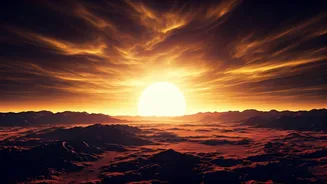
To make things even more peculiar, Venus rotates backwards. Unlike Earth and most other planets in the solar system, which spin counter-clockwise, Venus has a 'retrograde' rotation, spinning clockwise. [4, 10] If you could stand on its surface, you would see the Sun rise in the west and set in the east. [11] This backward spin has a profound effect on the length of a day as we would experience it—the time from one sunrise to the next, known as a 'solar day'.
The Never-Ending Sunrise
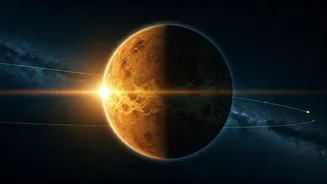
Because Venus is rotating backwards while it orbits the Sun, the two motions work against each other in a strange way. This actually makes the solar day on Venus shorter than its sidereal day. The time from one sunrise to the next on Venus is about 117 Earth days. [1, 3, 11] So, while a single spin takes 243 Earth days, you would only experience about two full day-night cycles in a Venusian year (225 / 117 ≈ 1.92). [10] A morning on Venus would last for nearly two Earth months. [1]
Why Is Venus So Strange?
Scientists are still debating the exact cause of Venus's slow, backward rotation. One leading theory suggests that early in its history, Venus was struck by a massive, planet-sized object that effectively knocked it upside down or reversed its spin. [1, 5, 7] Another compelling hypothesis points to Venus's incredibly thick and heavy atmosphere, which is about 92 times denser than Earth's. [2, 12] It's thought that powerful solar tides acting on this dense atmosphere could have generated enough friction over billions of years to slow the planet's rotation to a crawl and even reverse it. [4, 13] This atmospheric drag may be acting as a constant brake, preventing the planet's rotation from syncing up with its orbit. [12]