

A Gift from a Famous Comet
The Orionid meteor shower is a beautiful, recurring celestial event, but its origin story is what makes it truly special. The ‘shooting stars’ you see are actually tiny fragments of ice and dust shed by none other than Comet 1P/Halley, arguably the most
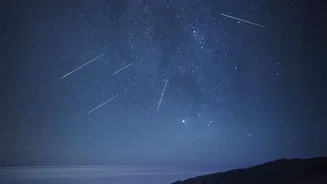
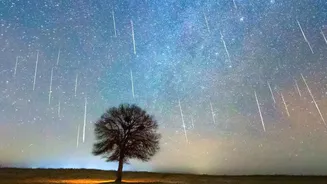
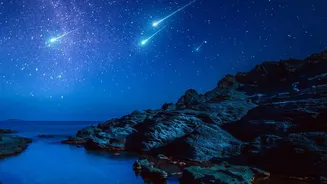
famous comet in history. As Halley’s Comet travels on its 76-year-long journey around the sun, it leaves a trail of cosmic debris in its orbit. Twice a year, Earth’s own orbit intersects with this trail of particles. In October, we pass through one of these debris fields, and the particles, some no bigger than a grain of sand, burn up upon entering our atmosphere at incredible speeds of around 66 kilometres per second. This fiery entry creates the brilliant streaks of light we call the Orionid meteors. So, while the comet itself won't return to our skies until 2061, this shower is a direct, visible link to its legacy.
When and Where to Look in India
The Orionid meteor shower is active from early October to early November, but the best time to watch will be during its peak on the night of October 21 and the pre-dawn hours of October 22, 2026. During this period, you can expect to see between 10 and 20 meteors per hour under ideal, dark-sky conditions. The name ‘Orionids’ comes from the constellation Orion, as the meteors appear to radiate from a point near its bright star, Betelgeuse. This radiant rises in the east after midnight, making the hours between 2 a.m. and dawn the prime viewing window. The main challenge for stargazers in 2026 is a bright, waxing gibbous moon, which will be in the sky for much of the night and can wash out the fainter meteors. However, for observers in India, there is a window of opportunity. The moon is expected to set around 3 a.m. local time, leaving a couple of hours of dark skies before sunrise for a better viewing experience.
Tips for the Best Viewing Experience
You don't need a telescope or binoculars to enjoy a meteor shower; in fact, your naked eyes are the best tool because they offer the widest field of view. The key is to find a location away from city and street lights, as light pollution is the biggest obstacle to seeing meteors. Find a comfortable spot, perhaps with a blanket or reclining chair, and lie flat on your back, looking generally up at the sky. Allow your eyes at least 20 to 30 minutes to fully adapt to the darkness—avoid looking at your bright phone screen during this time. Be patient, as meteors can appear in sporadic bursts. Orionid meteors are known for being particularly fast and can sometimes leave behind glowing trails, or 'trains', that linger for a few seconds. For the best chances in India, consider locations with historically clearer post-monsoon skies, like parts of Rajasthan or high-altitude regions like Ladakh or Spiti Valley, though any dark, open area will do.
A Cosmic Double Feature
The Orionids aren't the only meteor shower caused by Halley's Comet. Because Earth crosses Halley's orbital path at two different points, we get two meteor showers each year from the same comet. The other is the Eta Aquariid shower, which occurs in early May. This makes Halley's Comet the parent body of two distinct annual meteor showers. Viewing the Orionids is more than just watching random shooting stars; it’s a tangible connection to a celestial body that has been observed and recorded for millennia, featuring in historical records like the Bayeux Tapestry from 1066. Every streak of light is a piece of cosmic history burning brightly for a fleeting moment in our own atmosphere.