





Meet the Cigar Galaxy
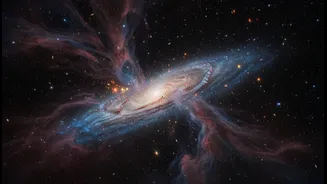
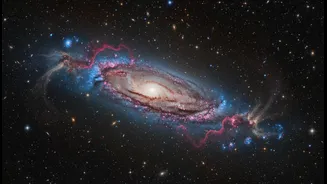
The subject of this makeover is Messier 82 (M82), more affectionately known as the Cigar Galaxy. Located about 12 million light-years away in the constellation Ursa Major, M82 is what astronomers call a 'starburst' galaxy. This means it's churning out new
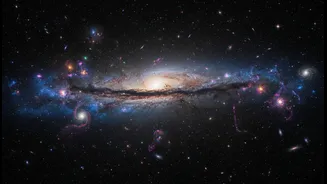
stars at a furious pace—about ten times faster than our own Milky Way. Viewed from Earth, the galaxy is tilted on its side, giving it an elongated, cigar-like appearance. For decades, it has been a prime target for astronomers, but much of its inner workings remained obscured by vast clouds of cosmic dust. That is, until now.
The Webb Makeover Revealed
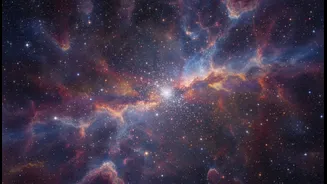
Previous observations by telescopes like Hubble gave us beautiful but incomplete views, with the galaxy's core shrouded in dark, dusty lanes. The James Webb Space Telescope, with its ability to see in infrared light, has effectively peeled back this dusty veil. The result is breathtaking. In Webb's new view, the core of M82 blazes with the light of millions of individual stars, appearing like luminous blue and white granules. Astronomers were able to resolve and map the positions of approximately 16.5 million stars, offering an unprecedented census of this bustling cosmic city. The image also reveals intricate red and orange filaments of material, tracing the structure of powerful galactic winds being blasted out from the galaxy's turbulent center.
Seeing Through the Dust
So, why is seeing through the dust so important? In starburst galaxies like M82, the very regions where new stars are born are the dustiest. This dust acts like a thick fog to telescopes that see in visible light, like Hubble. Webb's infrared instruments, however, can detect the heat signatures radiating through these clouds. This capability allows scientists to look directly into the stellar nurseries and analyze the conditions that trigger such intense bursts of star formation. One of the key discoveries from this new data is a clearer picture of the sooty chemical molecules known as polycyclic aromatic hydrocarbons (PAHs). These molecules trace the shape of the galactic wind and help scientists understand how the galaxy's star-forming frenzy drives material out into space, a process that will eventually regulate and even shut down future star birth.
A 'Beautiful Mess' with a History
Astronomers believe M82's frantic star formation was likely triggered by a past gravitational interaction with its much larger neighbor, the spiral galaxy M81. This cosmic encounter would have sent enormous quantities of gas pouring into M82's core, providing the raw fuel for its current starburst phase. Adam Smercina, an astronomer at the Space Telescope Science Institute, described M82 as a 'beautiful mess' that serves as an ideal laboratory for understanding galaxy evolution. By studying the millions of newly resolved stars, which act as a 'fossil record,' scientists can begin to piece together the galaxy's complex history and figure out how its star formation has moved and evolved over billions of years.