


The Sun’s Powerful Outbursts
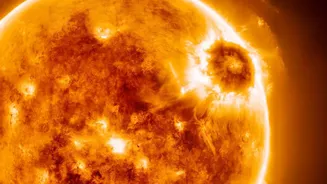
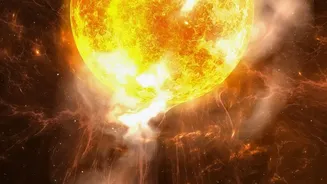
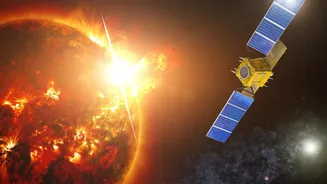
A Coronal Mass Ejection (CME) is a massive eruption of plasma and magnetic field from the Sun's corona, its outermost atmosphere. Think of it as the Sun throwing a giant, invisible cloud of magnetized particles into space. These clouds can travel at incredible
speeds, sometimes reaching Earth in just a couple of days. While our planet's magnetic field deflects most of this material, a direct hit can trigger significant space weather events. These are not just of interest to astronomers; they have real-world consequences for our highly technological society.
A Storm in Our Upper Atmosphere
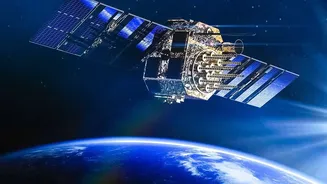
When a CME interacts with Earth's magnetic field, it causes a geomagnetic storm. This event dramatically disturbs the ionosphere, a layer of the upper atmosphere filled with charged particles (ions and electrons). The Global Positioning System (GPS) and other Global Navigation Satellite Systems (GNSS) work by sending precise radio signals from satellites to receivers on the ground. These signals must travel through the ionosphere to reach us. Under normal conditions, systems can account for the slight signal delay this layer causes. However, during a geomagnetic storm, the ionosphere becomes dense and turbulent, bending and delaying these critical signals in unpredictable ways.
GPS Under Solar Siege
For aviation, this is a serious concern. Modern aircraft rely heavily on GNSS for precise navigation, especially during take-off, landing, and for flying more efficient routes over oceans and polar regions. When the ionosphere is disturbed by a solar storm, the accuracy of GPS can be severely degraded. A system that is normally accurate to within a metre could suddenly have errors of tens of metres or more. In the worst-case scenario, a receiver might lose its lock on the satellites altogether, resulting in a temporary outage of navigation information. This interference can also affect high-frequency (HF) radio communications, another crucial tool for pilots, particularly on long-haul flights over remote areas.
The Power of Predictive Modeling
This is where impact modeling comes in. Scientists and space weather agencies, like NOAA's Space Weather Prediction Center (SWPC) and the European Space Agency (ESA), use data from satellites and ground-based observatories to create sophisticated computer models. These models aim to predict when a CME will hit Earth and, crucially, how it will affect the ionosphere. By simulating the complex physics of the sun-earth interaction, these models can forecast the location and severity of ionospheric disturbances. This gives the aviation industry something it desperately needs: an advance warning.
From Model to Cockpit
The forecasts generated by these models are not just academic exercises. They are translated into actionable advisories for the entire aviation sector. International bodies like the International Civil Aviation Organization (ICAO) use these advisories to alert air traffic control, airlines, and pilots about potential disruptions. Armed with this information, pilots and flight dispatchers can take proactive measures. They might be advised that GPS could be unreliable in a certain region for a specific period. In response, they can plan to rely on backup navigation systems, such as inertial reference systems (which use gyroscopes and accelerometers), or even adjust flight paths to avoid the most affected areas, particularly on polar routes.