




A Landmark Funding Milestone
Eka Robotics has successfully closed a $150 million Series A funding round, a significant vote of confidence from the investment community. The round was co-led by prominent venture capital firms Andreessen Horowitz (a16z) and F-Prime, with continued
support from previous investors like Obvious Ventures and E14 Fund. This substantial investment, which values the company at a staggering $1.45 billion post-money, is not just a win for Eka; it signals a pivotal moment for the deep-tech and robotics landscape in India. A Series A round of this magnitude typically indicates that a company has moved beyond the initial concept stage and is ready to scale its operations, accelerate customer deployments, and solidify its position in the market.
What is Eka Robotics?
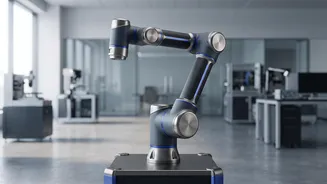
Founded by alumni from prestigious institutions like MIT and UC Berkeley, Eka Robotics aims to solve one of the most complex challenges in automation: dexterous manipulation. The company's mission is to build general-purpose robots that can perform physical tasks with superhuman capability while working safely alongside people. Unlike traditional industrial robots that are programmed for a single, repetitive task in a highly structured environment, Eka is developing machines that can understand the physical world and adapt to it. The team comprises pioneers in fields like reinforcement learning and AI, with experience from leading names such as DeepMind and Boston Dynamics.
The 'Vision-Force-Action' Breakthrough
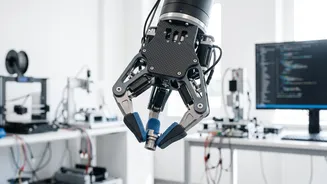
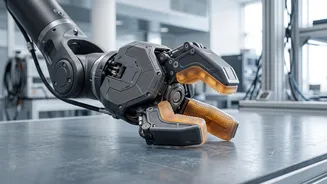
Eka's core innovation is its 'Vision-Force-Action' (VFA) model. Most robots rely primarily on vision—cameras that tell them where an object is. Eka's approach adds a crucial third sense: force. By integrating force sensors into its custom-built grippers, the robots can 'feel' what they are touching. This allows them to understand an object's properties, adjust their grip if it slips, and handle delicate or unfamiliar items with remarkable precision—tasks that have long been stumbling blocks for automation. Instead of being programmed by mimicking human actions, Eka's robots learn through trial and error in vast computer simulations, mastering physics to build an 'intuition' for how to interact with the world. This method allows them to generate thousands of hours of experience in minutes, dramatically accelerating the learning process.
From Lab Demo to Factory Floor
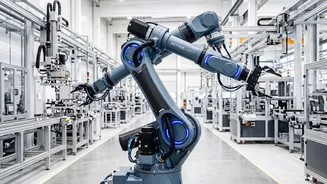
The results are impressive. Eka's robots have demonstrated the ability to pick and place over 1,500 varied objects per hour, more than double the average human speed. The same system that can sort items in a bin can also perform more complex tasks like screwing in a lightbulb or inserting wires, showcasing true general-purpose ability. This adaptability is crucial for industries like e-commerce, logistics, and manufacturing, where a wide variety of tasks need to be automated. With the new funding, Eka plans to scale its technology for more tasks and accelerate deployments with its industrial partners, who are already running pilots in areas like pick-and-place work and wire handling.
Powering India's Automation Future
Eka's success is part of a broader trend. India's robotics market is expanding rapidly, projected to grow from around $3.63 billion in 2026 to over $8 billion by 2034. The country is already the sixth-largest market for industrial robot installations globally. Government initiatives like 'Make in India' are pushing manufacturers to adopt automation to enhance efficiency and compete on a global scale. Startups like Eka are not just contributing to this trend; they are fundamentally shaping it. By developing homegrown, world-class robotics technology, they are positioning India as a creator, not just a consumer, of next-generation industrial automation, promising to enhance productivity across sectors from automotive to electronics.