






The Organism Behind the Glow
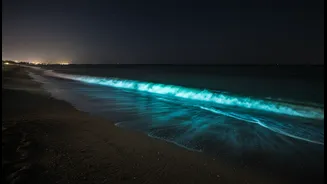
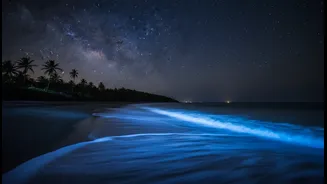
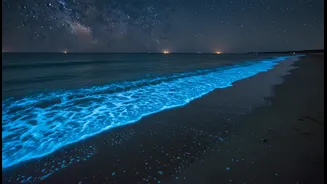
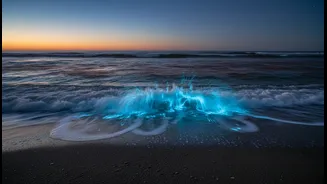
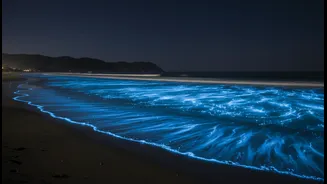
The star of this aquatic light show is a species of single-celled plankton called Noctiluca scintillans, commonly known as 'sea sparkle'. These microscopic organisms are dinoflagellates, and they drift with the ocean currents. They possess the fascinating
ability of bioluminescence, which is the production of light by a living organism. This light is the result of a chemical reaction involving a pigment called luciferin and an enzyme, luciferase. When the water is disturbed by waves crashing, a boat, or even a swimmer, these tiny plankton get agitated and flash their brilliant blue light as a defence mechanism, likely to startle or evade predators.
Mumbai's Geographic Traps
The unique shape of Mumbai's coastline plays a crucial role in concentrating these glowing plankton. The city's shoreline isn't a straight line; it's punctuated by a series of bays, coves, and estuaries, such as the famous Juhu beach and Mahim Bay. These natural formations act like geographical traps. As ocean currents push water towards the coast, these semi-enclosed areas cause the water to slow down and accumulate. Consequently, the Noctiluca floating within this water become highly concentrated in these pockets. This is why the glowing effect appears so intense along specific stretches of the coast rather than being evenly distributed. Without these bays, the plankton would likely be dispersed more widely by the currents.
A Nutrient-Rich 'Fertilizer' Effect
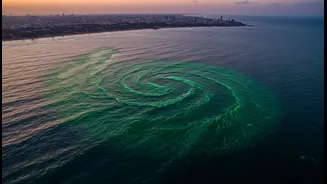
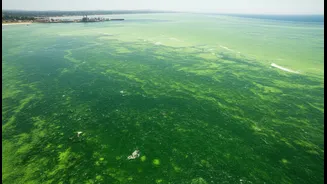
Geography alone doesn't create a bloom; the plankton need food to multiply into the vast numbers required for a visible glow. This is where Mumbai's urban character comes into play. The city's rivers, notably the Mithi River, and various drainage systems pour nutrient-rich water into the sea. This runoff, often containing untreated sewage, agricultural fertilizers, and industrial waste, acts as a powerful fertilizer for phytoplankton. These nutrients, particularly nitrates, create the perfect conditions for an algal bloom. While blooms can occur naturally, the high concentration of nutrients from urban outflows significantly amplifies their scale and frequency along the coast, providing a feast for Noctiluca scintillans.
The Role of Monsoons and Currents
The timing of these blooms is often linked to seasonal patterns. The phenomenon is frequently observed between November and January, following the monsoon season. During the summer monsoon, strong southwesterly winds drive a process called upwelling, which brings cold, nutrient-rich water from the deep ocean to the surface. After the monsoon, as conditions stabilize and sunlight becomes more abundant, the accumulated nutrients fuel a massive population explosion among the plankton. Winter conditions, with cooler surface temperatures, can also lead to convective mixing, which further churns up nutrients, supporting winter blooms. These seasonal oceanographic processes ensure that the plankton have everything they need to thrive just as coastal currents push them into Mumbai's waiting bays.
A Beautiful but Concerning Sign
While breathtakingly beautiful, these glowing tides are not necessarily a sign of a healthy marine ecosystem. Scientists see these intense blooms of Noctiluca scintillans as an indicator of environmental stress. These organisms are known to be voracious predators of diatoms, which form the base of the marine food web. Furthermore, as the massive bloom decays, the process consumes large amounts of dissolved oxygen in the water, creating oxygen-depleted 'dead zones' where fish cannot survive. The plankton also excrete ammonia, which can be toxic to fish populations. Therefore, the same factors that create the beautiful glow—excess nutrients from pollution and changing water temperatures, potentially linked to climate change—are also signals of an ecosystem under pressure.