





A Rhythmic Beat in the Darkness
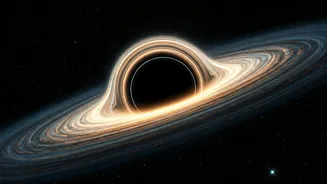
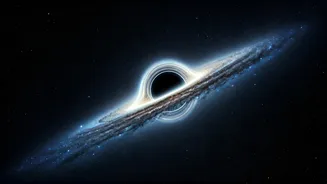
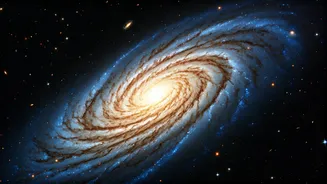
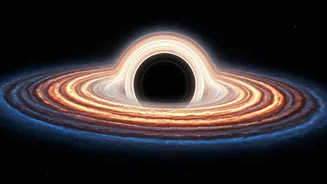
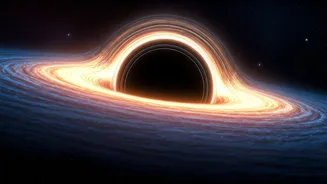
Supermassive black holes, cosmic titans millions or even billions of times the mass of our sun, are typically seen as engines of pure chaos. They sit at the centre of most large galaxies, including our own Milky Way, violently gobbling up any star, gas,
or dust that wanders too close. These cosmic meals are usually unpredictable, one-time events that create a dazzling, temporary flare. But recently, scientists have been captivated by a new pattern: some black holes are not just flaring, but flaring with a strange and thrilling regularity. This predictable pulsing has earned them the nickname “cosmic alarm clocks,” and they are changing how we study the universe’s most extreme objects.
The Dance of Giants
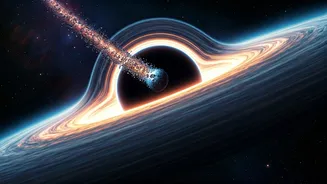
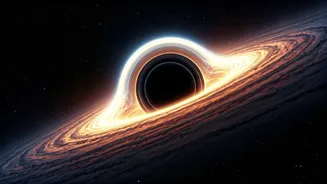
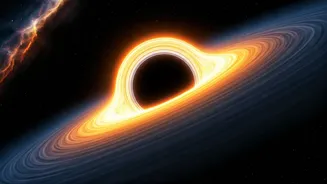
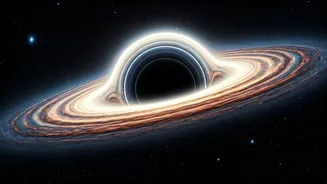
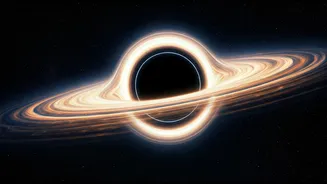
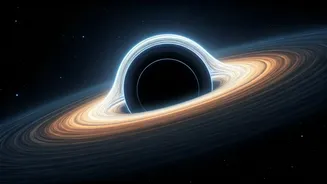
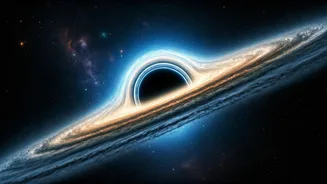
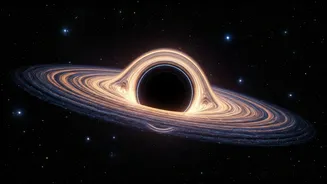
One of the most stunning examples of this phenomenon is an object known as OJ 287, located about 3.5 billion light-years away. For over a century, astronomers have noted that it erupts with incredible brightness roughly every 12 years. The cause is one of the most extreme pairings in the cosmos: a 'small' supermassive black hole, itself 150 million times the sun's mass, orbiting a much larger partner that weighs in at a staggering 18 billion solar masses. The smaller black hole is on a tilted, elliptical path. Twice during its 12-year orbit, it punches directly through the vast, swirling disc of gas and dust that feeds the larger black hole. Each collision creates a gargantuan flare of energy, a predictable burst of light that scientists can now anticipate with remarkable accuracy.
A Star's Lingering Demise
Another type of cosmic clock involves a different kind of violent relationship. This occurs when a star doesn't get swallowed whole by a black hole but is instead caught in a looping, elliptical orbit. When a star gets too close, the black hole's immense gravity strips away some of its outer layers in what’s called a partial tidal disruption event, or TDE. Think of it as the black hole having a “snack” instead of a full meal. The star survives the encounter and continues on its orbit, only to be stripped again on its next close approach, creating another flare. Astronomers have identified candidates for this behaviour, such as an event named ASASSN-22ci, which is expected to flare again in early 2026, offering a perfect test of the theory.
Why This Regularity Is a Game-Changer
The discovery of this periodicity is more than just a curiosity; it's a revolutionary tool for physics. A chaotic, one-off flare gives scientists a single snapshot of a black hole's behaviour. But a repeating, predictable flare creates a natural laboratory in space. By timing the flares from systems like OJ 287, astronomers can test the limits of Einstein’s theory of general relativity in extreme gravitational fields. The regularity allows them to precisely measure the black holes' masses, their spin, and the properties of the accretion disks surrounding them. It transforms these distant, mysterious objects into systems that can be studied with the predictable precision of clockwork, allowing for deeper insights into how black holes grow and influence their host galaxies.
The Search for More Cosmic Clocks
With these discoveries, the hunt is now on for more of these rhythmic behemoths. Astronomers are combing through vast archives of sky survey data, looking for repeating transients—flickers of light from the same spot in the sky separated by months or years. Each new discovery of a periodic black hole provides another invaluable data point. It helps confirm that these events are not just cosmic flukes but a genuine, if rare, class of astrophysical phenomena. Finding more will allow scientists to build a more comprehensive model of black hole interactions, moving beyond studying singular events to understanding the long-term, dynamic evolution of the relationship between black holes and the stars and gas that surround them.