





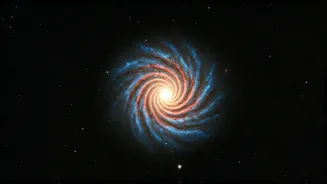


A New Cosmic Tapestry
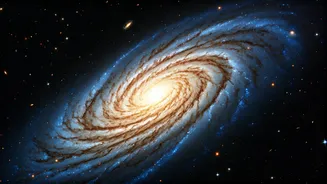
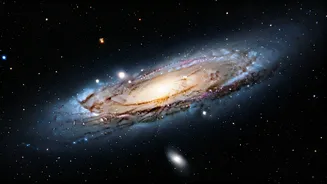
The subject of this extraordinary cosmic portrait is the Triangulum galaxy, also known as Messier 33 (M33). Located about three million light-years from Earth, it's the third-largest member of our Local Group of galaxies, after Andromeda and our own Milky
Way. This image, one of the largest ever released by Hubble, is not a single snapshot but a masterful mosaic. It was stitched together from 54 separate fields of view, creating a panoramic vista that showcases the galaxy's central region and its inner spiral arms in unprecedented detail. The final product is a 665-million-pixel image that allows astronomers to resolve an estimated 15 to 25 million individual stars, a feat of technological prowess that turns a distant, blurry object into a vibrant stellar city.
More Than Just a Pretty Picture
While visually stunning, the image is a scientific treasure trove. Triangulum is a spiral galaxy like our own, but with some key differences. It lacks a bright, dense bulge of stars at its core and shows few signs of past interactions with other galaxies. Its orderly, face-on orientation toward us makes it an ideal laboratory for studying how stars are born and how spiral structures are maintained. Scientists were immediately struck by the galaxy's prolific rate of star formation, which is about ten times more intense than in comparable regions of the Andromeda galaxy. The image is dotted with bright blue regions and glowing pink clouds of ionized hydrogen, known as H II regions, which are cosmic nurseries where new stars are actively forming. One of these, NGC 604, is one of the largest known star-forming regions in our entire Local Group.
The Technology Behind the View
Capturing such a detailed view required the unique capabilities of the Hubble Space Telescope, a project of international cooperation between NASA and the European Space Agency (ESA). Floating above the distortion of Earth's atmosphere, Hubble's Advanced Camera for Surveys methodically captured dozens of images over many months. These individual frames were then meticulously combined into a single, seamless mosaic. This technique allows the telescope to create an image far larger and more detailed than a single exposure could ever achieve. The resulting panorama covers a swath of the Triangulum galaxy spanning over 14,000 light-years across. This technological achievement provides astronomers with a powerful tool to map the distribution, age, and characteristics of stellar populations, offering deep insights into the life cycle of galaxies.
Our Cosmic Neighbor
The Triangulum galaxy is relatively small, measuring about 60,000 light-years in diameter compared to the Milky Way's 100,000. It may contain around 40 billion stars, a fraction of the Milky Way's estimated 400 billion. Despite its smaller stature, it's one of the most distant objects that can be seen with the naked eye under perfect dark-sky conditions, appearing as a faint smudge in the constellation Triangulum. Its relative proximity and high rate of star formation make it a critical subject for understanding galactic evolution. Some astronomers suspect it may be a gravitational companion to the much larger Andromeda galaxy, and both are on a long-term trajectory toward our own, potentially setting the stage for a spectacular cosmic interaction billions of years from now.