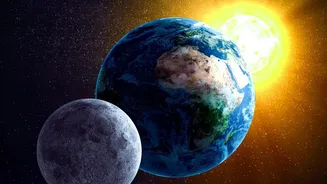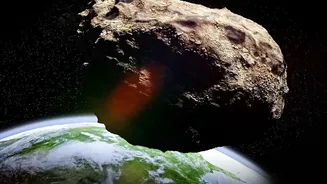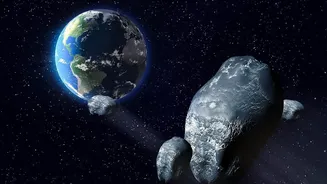

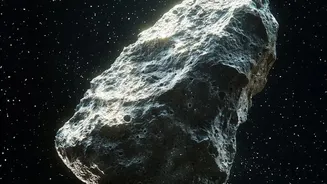

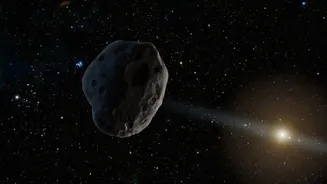
For the past several months, Earth has had a secret companion. Beyond our familiar Moon, a tiny asteroid designated 2026 QQ8 has been circling our planet, a temporary 'minimoon' captured by our gravity. Now, its visit is ending.
What is a 'Minimoon'?
While our planet has only
one large, permanent natural satellite, it occasionally collects temporary companions. These so-called 'minimoons' are small near-Earth asteroids that, due to their speed and trajectory, get caught in Earth's gravitational pull for a short time. Unlike the Moon, their orbits are often chaotic and unstable, influenced by the complex gravitational dance between the Earth, Moon, and Sun. The asteroid 2026 QQ8, estimated to be just a few meters in diameter, much like a small car, was first spotted by astronomers in late 2025. After initial observations to rule out the possibility of it being space debris, its path was confirmed: it was a natural object temporarily bound to Earth.
A Rare but Welcome Visitor
Finding these minimoons is a significant challenge. Their small size and dimness make them incredibly difficult to detect with most telescopes. Simulations suggest that at any given time, there might be at least one such object a meter or more in size orbiting Earth, but only a handful have ever been confirmed by astronomers. Previous documented visitors include 2006 RH120 and 2020 CD3, each of which orbited our planet for about a year or more before being ejected back into an orbit around the Sun. Each discovery provides a rare, low-cost opportunity to study a near-Earth asteroid up close, offering insights that would otherwise require expensive space missions.
The Science of a Temporary Satellite
The visit of 2026 QQ8 has been a boon for planetary scientists. By observing the light reflected from its surface, they can gather data about its composition. Many of these objects are thought to be C-type, or carbonaceous, asteroids, which are among the most ancient objects in the solar system. Some recent studies have even suggested that some minimoons could be fragments of our own Moon, blasted into space by ancient impacts. Tracking 2026 QQ8's looping, unstable orbit has also allowed researchers to refine their models of how this gravitational capture process works. The complex three-body problem involving the Earth, Moon, and the asteroid makes for a wild ride, and watching it unfold in real-time provides invaluable data.
A Final Farewell Orbit
According to orbital calculations, 2026 QQ8 was captured by Earth's gravity in the spring of 2026. Now, after several looping orbits, its trajectory is carrying it towards the edge of Earth's gravitational influence. Astronomers project that in early December, the tiny asteroid will be flung out of our planet's orbit, a bit like a slingshot, and will resume its independent journey around the Sun. There is no risk of the object colliding with Earth. Observatories are carefully tracking this final departure, as the process of orbital ejection is just as scientifically interesting as the capture. This farewell tour is the last chance to gather data before our temporary companion disappears back into the vastness of space.