






The Physics of Falling with Style
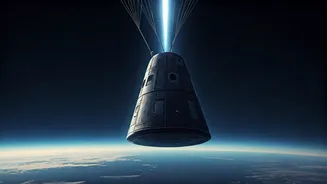
When a capsule like NASA's Orion returns from the Moon, it hits the top of Earth's atmosphere at over 25,000 miles per hour. The first and most powerful brake is the atmosphere itself. The capsule's blunt, shielded bottom creates immense drag, converting
kinetic energy into intense heat and slowing the vehicle dramatically. But atmospheric braking alone isn't enough. By the time the capsule is in the thicker, lower atmosphere, it's still traveling at over 300 mph—far too fast for a safe landing. This is where the parachutes take over, tasked with managing the final, critical moments of descent and reducing the speed to a gentle 20 mph or less for splashdown.
A Symphony of Chutes
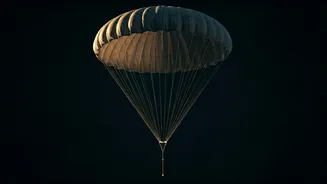
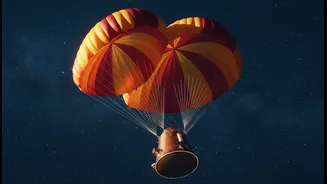
Landing a spacecraft isn't a one-parachute job. It’s a carefully choreographed sequence involving multiple types of chutes. First, at an altitude of about five miles, small mortars fire to deploy two drogue parachutes. These are designed to stabilize the capsule at high speeds, stop it from tumbling, and provide the initial, significant slowdown. They are built to withstand supersonic forces. After the drogues have done their job and slowed the craft to around 130 mph, they are cut away. Then, pilot chutes deploy, which are smaller parachutes whose sole purpose is to pull the massive main parachutes from their densely packed compartments. This multi-stage process ensures the main parachutes aren't ripped to shreds by deploying at too high a velocity.
Engineering for Extreme Reliability
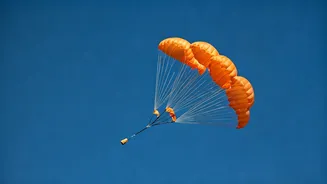
The main parachutes on a modern capsule are feats of engineering. Each of Orion's three main chutes is 116 feet in diameter, and combined they would cover a football field. They are made from a hybrid of nylon and Kevlar, materials chosen for their strength and light weight. The suspension lines alone can total miles in length. Because failure is not an option when human lives are at stake, these systems are built with redundancy. SpaceX's Dragon capsule uses four main parachutes, and both Dragon and Orion are designed to land safely even if one of their main parachutes fails to deploy. This requires thousands of hours of analysis and dozens of real-world drop tests, intentionally failing parts of the system to ensure the backups work perfectly under extreme stress.
A Source of Modern Headaches
Despite being a proven technology, parachutes remain a significant engineering challenge, often cited by engineers as a major source of anxiety. The physics of how a parachute inflates in turbulent, high-speed air is incredibly complex and difficult to model with computers. This makes extensive, expensive physical testing essential. Boeing's Starliner program faced significant delays and scrutiny due to its parachute system. A 2019 pad abort test saw one of its three main parachutes fail to deploy due to a simple pin not being secured correctly before packing. This highlighted how a tiny, overlooked detail in a low-tech component can jeopardize a multi-billion dollar space program. A recent NASA audit report also highlighted parachute anomalies as one of the longstanding technical challenges for the Starliner program.