





The Thinking Robot: Autonomous Navigation
Imagine trying to drive a car with a 20-minute delay on your steering, acceleration, and brakes. That's the challenge NASA faces every day with Perseverance, as radio signals take that long to travel one-way between Earth and Mars. This communication
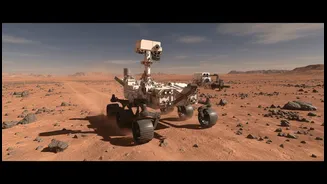
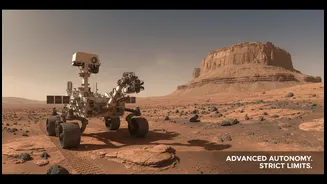
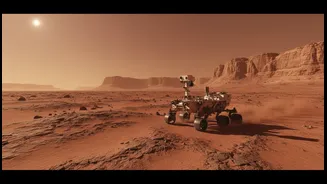
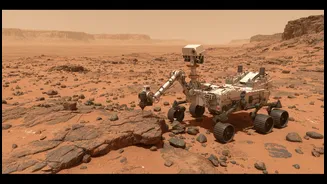
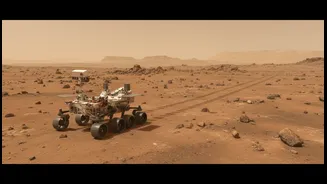
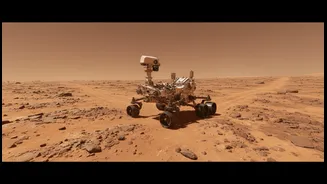
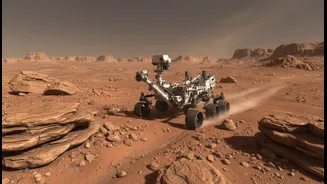
lag makes real-time control impossible. Enter AutoNav, the rover's brilliant autonomous navigation system. It's a significant upgrade from previous rovers, with a capability called "thinking while driving." While its predecessor, Curiosity, had to stop, take pictures, and then plan its next move, Perseverance can analyse the terrain and make decisions while its wheels are still turning. Using a dedicated navigation computer and 3D maps created by its stereo cameras, AutoNav identifies hazards like sharp rocks and treacherous sand traps, and plots the safest, most efficient path forward. This allows Perseverance to cover far more ground—up to 120 meters per hour compared to Curiosity's 20—enabling it to reach new scientific targets much faster. It’s like an ultra-marathoner that can see the trail ahead and choose its own footing, rather than waiting for instructions at every step.
The Coaching Staff: Earth's Remote Commands
While AutoNav gives Perseverance independence on a tactical level, its overall mission is still guided by human hands from NASA's Jet Propulsion Laboratory (JPL). Engineers and scientists act as the rover's long-distance coaching staff. They use NASA’s Deep Space Network (DSN) to send carefully bundled packages of commands that dictate the rover's strategic goals for the coming Martian day, or 'sol'. These commands aren't simple joystick movements; they are complex sequences like, "drive to this waypoint, then use your robotic arm to analyse that rock." To make this possible, most of the data—especially large science files and images—is first relayed to one of several orbiters circling Mars. These satellites then act as powerful intermediaries, sending the data back to Earth much more efficiently than the rover could alone. The process is reversed for commands sent from Earth. This system of remote command and data relay ensures that even with the immense distance, the mission's scientific objectives are precisely executed, directing the autonomous explorer towards the most promising areas in its search for signs of ancient life.
Built to Endure: Durable Hardware
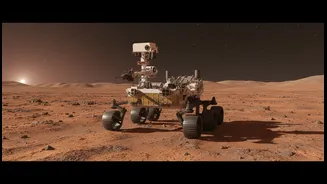
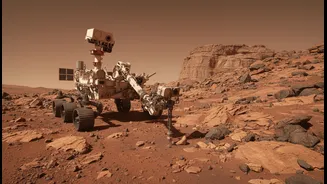
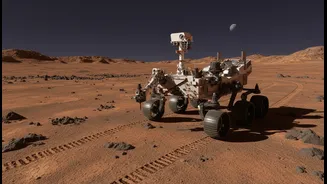
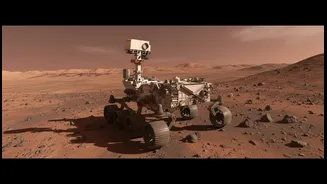
Perseverance's scientific marathon would be impossible without a body built for the brutal Martian environment. Its hardware is a masterclass in resilient engineering. A key element is its power source, the Multi-Mission Radioisotope Thermoelectric Generator (MMRTG). This nuclear battery converts heat from the natural decay of plutonium-238 into a steady supply of electricity, giving it a mission life that can span more than a decade, far outlasting what solar panels could offer on the dusty planet. This system also provides essential heat to keep the rover's electronics from freezing in the extreme cold. The rover's mobility relies on six robust aluminum wheels, which were redesigned to be stronger than Curiosity's after that rover experienced significant wear and tear. Perseverance's wheels are thicker and feature curved titanium spokes for support, allowing them to traverse sharp rocks and rugged terrain. The entire assembly is connected to a 'rocker-bogie' suspension system that keeps the rover stable and can climb over obstacles as tall as its own wheels. This combination of a long-lasting power source and rugged, durable hardware ensures Perseverance can keep roving for many years to come.