


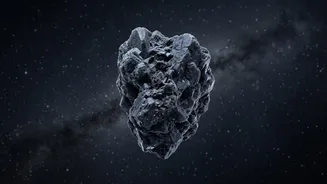
Our Solar System's Icy Attic
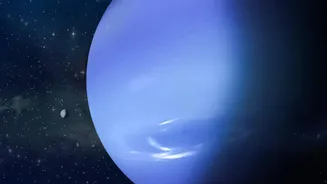
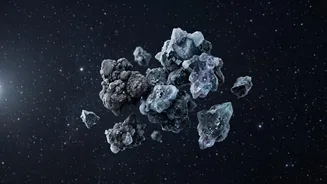
Imagine the solar system not just as the Sun and its eight planets, but as a vast home with a sprawling, cluttered attic. This is the Kuiper Belt, a donut-shaped region of icy, rocky bodies that begins near Neptune's orbit, about 30 times farther from
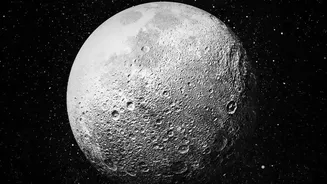
the Sun than Earth is. For decades, astronomers believed this belt of planetary leftovers petered out around 50 times Earth's distance from the Sun. It's a realm populated by dwarf planets like Pluto and hundreds of thousands of other frozen objects, each a pristine relic from the dawn of our solar system. These Kuiper Belt Objects (KBOs) are considered the building blocks of planets, holding secrets about how our cosmic neighborhood came to be. But because they are so small, dark, and distant, studying them directly is incredibly challenging.
A Trail of Cosmic Breadcrumbs
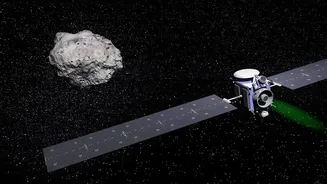
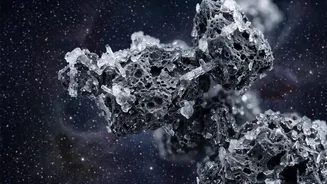
This is where NASA’s New Horizons spacecraft comes in. Launched in 2006, this intrepid explorer gave us our first close-up look at Pluto in 2015 and the KBO Arrokoth in 2019. But its mission didn't end there. As it continues its journey through this remote region, it’s using a special instrument to 'listen' for clues: the Venetia Burney Student Dust Counter (SDC). Designed and built by students at the University of Colorado Boulder, the SDC is essentially a set of sensitive panels that register impacts from microscopic dust grains. These particles are the 'breadcrumbs' left behind when larger KBOs collide with each other or get pelted by even tinier specks of dust from interstellar space. By counting these impacts, scientists can create a map of dust density, which tells them about the unseen population of objects creating it.
More Dust Than Expected
As New Horizons traveled beyond 45 astronomical units (AU), or 45 times the distance from Earth to the Sun, the SDC started detecting something surprising. Scientific models predicted that the amount of dust should begin to decrease, as the spacecraft was supposedly nearing the edge of the Kuiper Belt. Instead, the instrument detected higher-than-expected levels of dust. The readings, compiled over three years as the spacecraft journeyed from 45 to 55 AU, defied expectations. This wasn't a small anomaly; it was a consistent stream of evidence suggesting that our map of the outer solar system might be incomplete. The logical conclusion is that something out there is producing this extra dust, and the most likely culprit is a population of KBOs that we didn't know existed.
What It Means: A Bigger Belt?
The discovery has led to a fascinating new theory: the Kuiper Belt may be significantly larger than we thought. The growing body of evidence, supported by new ground-based telescope discoveries of distant KBOs, suggests the belt might not end at 50 AU, but could extend as far out as 80 AU or even farther. Another possibility being considered is the existence of a second, more distant Kuiper Belt beyond the main one. This extra dust helps solve a long-standing puzzle. For years, observations of other star systems have shown dusty debris disks that appeared much larger than our own Kuiper Belt was thought to be. These new findings suggest our solar system might be more similar to those other systems than previously believed. The dust reveals a more active and populated outer solar system, where collisions continue to shape the landscape billions of years after the planets formed.
The Journey Continues
New Horizons is still going strong, with enough power and fuel expected to last into the 2040s. As it ventures past 60 AU and heads toward 100 AU, its dust counter will continue to provide invaluable data. Scientists are eager to see how far these elevated dust levels extend. Eventually, the spacecraft is expected to cross a boundary into a region where the dust environment is dominated not by our solar system's debris, but by particles from interstellar space. The SDC's measurements will provide the first-ever direct glimpse of this transition. Each new particle impact recorded by New Horizons adds another piece to the puzzle, painting a richer and more complex picture of the solar system's edge. It's a reminder that even the smallest, most distant specks of dust can tell us some of the biggest stories about our place in the cosmos.