



What is Your Deep Core?
When most people think of 'core muscles', they picture the rectus abdominis, or the 'six-pack' muscles. But your true core is much deeper. It’s a group of stabilizing muscles that includes the transverse abdominis, multifidus, diaphragm, and the pelvic
floor. Think of these muscles as a natural corset that wraps around your torso, protecting your spine and providing a solid base for all movement. A strong deep core is crucial for good posture, preventing lower back pain, and improving your overall balance and stability in daily activities.
The Plank: Your Foundation
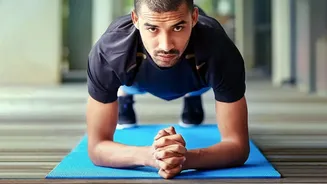
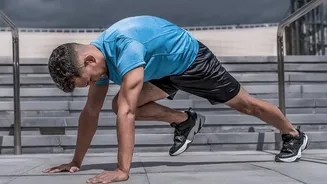
The plank is a fundamental exercise for a reason: it engages the entire core. But proper form is everything. Start on your forearms and toes, with your elbows directly under your shoulders. Engage your core by pulling your belly button towards your spine and squeeze your glutes. Your body should form a straight, rigid line from your head to your heels. Avoid letting your hips sag or rise too high. Focus on creating full-body tension rather than just holding the position for as long as possible. If you feel your lower back arching, you've lost engagement. Start with short holds of 20-30 seconds, prioritizing perfect form.
The Dead Bug: Master Core Control
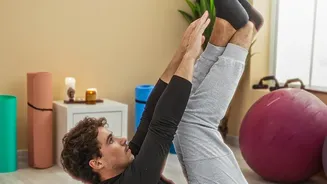
This exercise is deceptively challenging and excellent for training your core to stabilize your spine while your limbs are in motion. Lie on your back with your arms extended toward the ceiling and your knees bent at a 90-degree angle directly over your hips. Press your lower back gently into the floor; there should be no arch. Inhale, then as you exhale, slowly lower your right arm and left leg toward the floor simultaneously. Go only as low as you can without your lower back lifting off the ground. Return to the starting position with control and repeat on the other side, lowering your left arm and right leg. That’s one repetition.
The Bird-Dog: For Balance and Stability
The bird-dog improves stability by challenging your body to resist rotational forces. Start on all fours, with your hands directly under your shoulders and your knees under your hips. Keep your spine in a neutral position. Engage your core, then slowly extend your right arm straight forward and your left leg straight back, creating a straight line from your fingertips to your heel. Your hips and shoulders should remain square to the floor—avoid the temptation to rotate open. Hold for a moment before returning to the start with control. Alternate sides with each repetition.
Glute Bridge: Powering Your Posterior Chain
Your core isn't just about your abs; your glutes and lower back are integral parts of the system. The glute bridge strengthens them effectively. Lie on your back with your knees bent, feet flat on the floor about hip-width apart, and your arms resting by your sides. Engage your core and glutes to lift your hips off the floor until your body forms a straight line from your shoulders to your knees. Avoid over-arching your back at the top. Hold the position for a few seconds, squeezing your glutes, before slowly lowering your hips back down to the starting position.
Creating a Simple Routine
Consistency is more important than intensity when building deep core stability. You don't need a long, grueling workout. Aim to perform these exercises 3-4 times per week. Start with 2-3 sets of each exercise. For planks, hold for 20-45 seconds. For dead bugs and bird-dogs, aim for 8-12 repetitions per side. For glute bridges, aim for 12-15 repetitions. Listen to your body and focus on slow, controlled movements. The goal is to feel the deep muscles working, not to power through the motions. As you get stronger, you can increase the duration of your holds or the number of repetitions.